
Bradenton Tree Removal provides arborist inspections and tree risk assessments across Bradenton, FL, serving surrounding cities including Samoset, Palmetto, Bayshore Gardens, Ellenton and Memphis. Twenty-plus years of working these soils and these species is what the assessment rests on: knowing what a mounded root plate looks like in saturated flatwoods sand, and which structural defect on a mature laurel oak is the one that matters.
This page exists because in Florida the assessment is not optional paperwork attached to a removal — it is often the thing that makes the removal legal without a permit. Florida Statutes section 163.045 turns on documentation that only two credentials can produce, and a homeowner who hires a crew first and asks about documentation afterwards has the order backwards.
Every tree we recommend taking down gets a written condition report first, and every tree we recommend keeping gets the same document. The reasoning goes on the record before a saw starts, which is what makes it useful a year later to an insurer, a board, a buyer’s inspector, or the owner deciding whether last summer’s advice still holds.
Tree Risk Assessment Under Florida Statutes Section 163.045
What the Statute Actually Requires
Section 163.045 bars a local government from requiring a notice, application, approval, permit, fee or mitigation for pruning, trimming or removing a tree on qualifying residential property when the owner possesses signed documentation that the tree presents an unacceptable risk. The operative word is possesses: the document has to exist and be in the owner’s hands before the work, not assembled afterwards to justify it. It also bars any replanting requirement for that removal.
The ISA Tree Risk Assessment Method
The statute does not leave the standard open. It points at an onsite assessment performed under the ISA Best Management Practices Tree Risk Assessment, Second Edition 2017, which is a structured method rather than an opinion: likelihood that the part fails, likelihood it strikes a target, consequences if it does, combined into a rated risk. That structure is why the result survives scrutiny and why a photograph sent by text does not qualify as one.
Who Can Sign, and Why That Is the Whole Point
Only an ISA-certified arborist or a Florida licensed landscape architect can sign the section 163.045 documentation. That narrow list is unusually important in this state, because Florida issues no tree or arborist contractor license and section 163.211 preempts local governments from creating an occupational license for the trade. The certification held by the person signing is therefore the one qualification in Florida tree work that a property owner can independently verify.
Who the Preemption Covers, and Who It Does Not
Single-Family Detached Homes
The statute defines residential property narrowly: a single-family, detached building on a lot actively used for single-family residential purposes. If that describes your address, the documentation route is open and the local permit falls away for the tree it names. It does not extend to a second tree, to a neighbor’s property, or to work on the same lot a year later — each assessment covers what it inspected, on the date it inspected it.
Condominiums, Associations and Community Development Districts
Attached housing, condominium parcels, townhomes, mobile and manufactured homes and association common areas all sit outside that definition, and the local ordinance applies to them in full. Here the assessment does different work: it supports the permit application, gives the board a defensible reason for the spend, and puts a priority order on a list of trees so a district can budget across several years rather than reacting to whichever one drops a limb first.
Commercial Property, Campuses and Municipal Grounds
Commercial, industrial, agricultural and institutional parcels are also outside the preemption, and they carry a duty of care that a private yard does not. Where the target beneath a tree is a parking row, a walkway, a playground or a loading area, the consequences leg of the assessment changes the rating even when the defect is identical. Documented inspection cycles are what turn that exposure into something a risk manager can show.
What We Inspect on a Florida Site
Root Plate, Root Collar and the Soil Under It
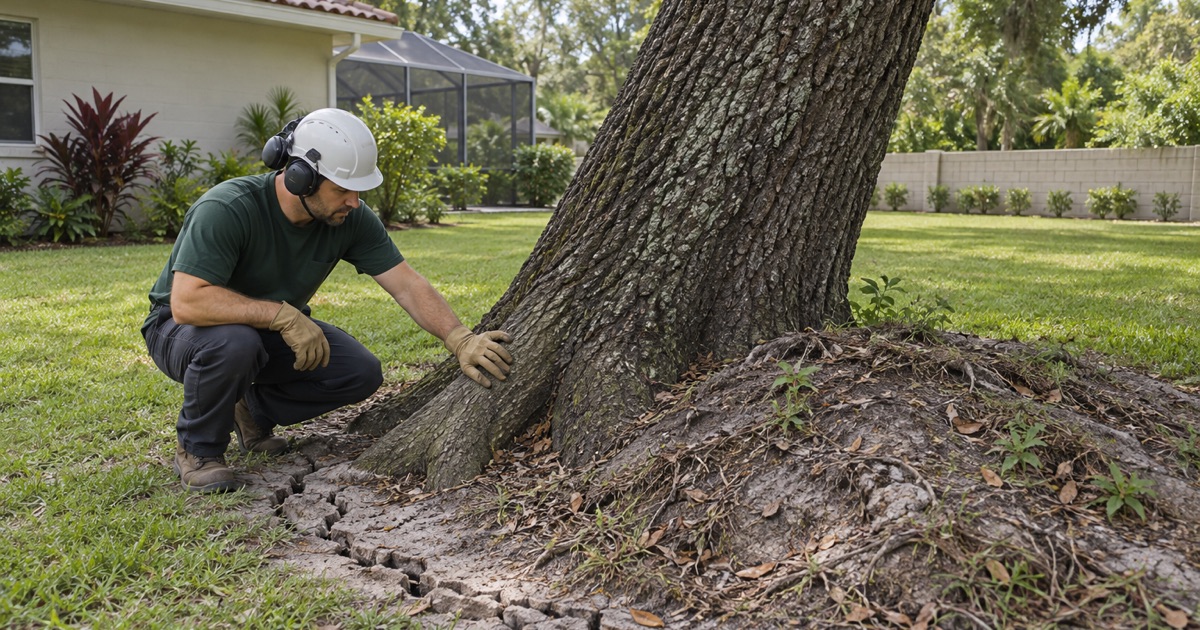
Most of what decides whether a mature tree stands through a storm is underground and invisible. We look for a lifted or cracked root plate, a root collar buried by years of mulch or fill, and roots severed by a driveway, a pool deck, a seawall or a utility trench. Where the collar is buried, root collar excavation with an air spade shows what is actually happening at the base rather than what the mulch suggests.
Structural Defects in the Canopy
Above ground the recurring findings are co-dominant stems joined with included bark, old topping wounds carrying weakly attached regrowth, decay pockets, cavities and one-sided crowns on trees that lost a neighbor. Live oak and laurel oak look similar from a driveway and behave differently under load, and laurel oak in particular ages into decay far sooner. We record the defect, its location and its size, not just a verdict.
Palms Are Assessed on Their Own Terms
A palm has one growing point, no cambium and no capacity to compartmentalize a wound, so nothing from hardwood assessment transfers. We look for a Ganoderma conk at the base, the blackened flower stalks and premature fruit drop that precede lethal bronzing symptoms in the canopy, spear leaf collapse, the permanent taper of pencil-pointing from past over-pruning, and the translucent spotting of potassium deficiency in the oldest fronds.
The Report, and What It Is For
What a Written Condition Report Contains
Each report names the tree, its species and diameter at breast height, the defects observed and where they are, the target beneath it, the risk rating and the recommendation with its reasoning. Photographs are attached to the findings they support. It is written to be read by somebody who was not there — an adjuster, a manager, a buyer’s inspector, or you in eighteen months when the site visit is a memory.
When the Recommendation Is Not Removal
A co-dominant union with included bark on an otherwise sound shade tree is frequently a cabling and bracing case rather than a removal, and a crown that is heavy over a roof is often a directional pruning case. Compacted soil over a root plate responds to decompaction rather than to a chainsaw. Where planting is the right long-term answer, the report says what suits the drainage and the space, without pretending it is a code requirement when it is not.
Second Opinions and Absentee Owners
A fair share of our assessment work is a second opinion on somebody else’s removal quote, and a fair share of that ends with the tree still standing. Seasonal residents, home watch services and out-of-state owners get the same findings and photographs delivered in writing, so an inspection carried out in June still means something to an owner who arrives in November.
- 20+ Years on This Coast
- Written Estimates
- No Topping, No Hat Racking