
Bradenton Tree Removal treats tree removal in Balm as farm-country work first and yard work second, because out here the way a parcel is classified changes which rulebook applies before a saw ever leaves the truck. Twenty-plus years on this coast has taught us that the answer to “do I need a permit” at a Balm address depends on how the land is coded, not on how the property looks from the road.
What we do here is the ordinary range of the trade done to that distinction: removals, storm-damage clearing, structural pruning, palm work, and stump grinding on parcels that run from a single lot to a working field. Palms and hardwoods get treated as the different jobs they are, by crews who know a palm has no branch collar to cut to.
Every job starts with a written estimate, with hauling and disposal priced as their own line so you can see what moving the wood actually costs. If a tree does not need to come down, we say so and put the reasoning in writing, including the times pruning or a cable is the honest recommendation.
The state’s homeowner exemption does not reach farmland
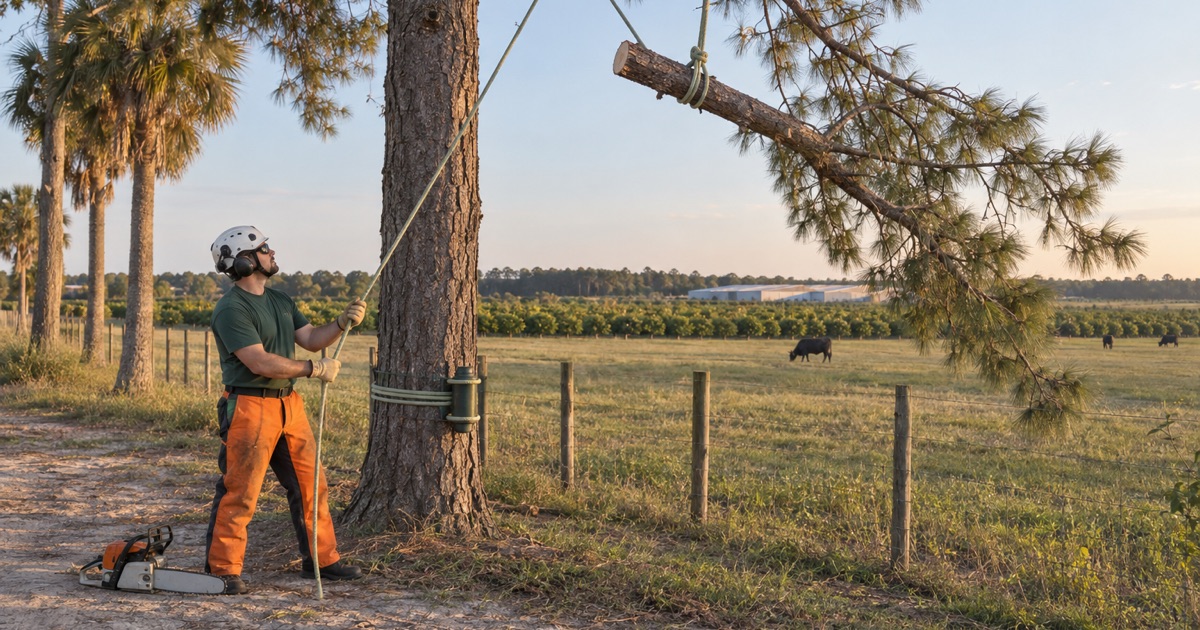
Florida’s dangerous-tree exemption is usually the first thing an owner has read before calling us, and on agricultural ground it is the first thing we have to set aside. Florida Statutes section 163.045 defines residential property as a single-family, detached building located on a lot that is actively used for single-family residential purposes. Land the County Property Appraiser has designated agricultural does not meet that definition, whatever structures stand on it.
So we will not quote a working farm parcel on the strength of an arborist letter written under that statute. It gives no cover there, and a crew that proceeds as though it does is exposing the owner rather than protecting them. What replaces it is the county’s own regime, which happens to be broader, but it is a different authority with different conditions and the swap has to be made deliberately.
Who actually issues the permit at a Balm address
This is unincorporated county ground with no city hall above it, so the Hillsborough County Board of County Commissioners is the only government that permits a tree removal here. The county’s residential guide states plainly that its rules apply only inside unincorporated Hillsborough County, and the Development Services Department’s Natural Resources Section is where a residential permit under the code’s tree and vegetation article is read and issued.
Where a parcel here is residential rather than agricultural, the ordinary county rules apply in full: the permit-threshold chart, the exempt-species list and the Grand Oak point system all bind exactly as they do elsewhere in the unincorporated county. That guide also still labels the dangerous-tree pathway by its 2019 bill number rather than the current statute, and says nothing about the single-family-detached limit. That silence is the exact gap a farm owner falls into, which is why classification is the single most consequential fact behind a quote at an address here.
Looking for tree-removal closer to Gibsonton? See Tree-Removal in Gibsonton.
The county’s agricultural exemption, and what it actually allows
What an existing farm can do without filing anything
The county’s agricultural exemption to its Natural Resources permit covers activities that are normal and necessary to conduct bona fide agricultural operations in properly zoned areas. Whether a parcel qualifies is judged partly on the specific agricultural use of the property, the property size relative to that use, and whether the land is designated as agricultural by the County Property Appraiser. Those are the questions we work through before pricing a farm job, because they decide whether the work is exempt or whether an application has to come first.
An existing, bona fide agricultural operation does not have to apply for the exemption at all in order to carry out a defined list of everyday work. Tree removal under Land Development Code section 4.01.03 is named on that list, as is tree trimming performed to ANSI A300 standards, and so is limited tree removal or trimming carried out for crop production on an existing farm. Field preparation and planting, routine replacement of dead or diseased crop, plant-material removal from plant farms, irrigation and pond or drainage maintenance, and fire-line maintenance sit alongside them.
What still needs an application, and the limits that ride along
Two kinds of farm work are outside that walk-in list. Converting natural land to pasture and standing up a forestry operation both require a formal exemption application, which is a different conversation and a different timeline from taking out a windrow of dead trees.
The land-alteration side of the exemption carries hard conditions we plan the job around. The work may not remove more than 500 cubic yards of material offsite, may not adversely impact environmentally sensitive upland or wetland areas, and may not impede or divert surface water flow onto a neighboring property, and any fill has to conform to the code’s placement-of-fill provisions. On a large clearing job that offsite cap is a volume question before it is ever a paperwork question, which is why we put the hauling and disposal number where you can see it rather than folding it into a lump sum.
The residential side of the same county is stricter about debris in a different way: landscaping and tree-trimming contractors are barred from putting their work onto a residential curbside account, so a homeowner’s job here routes debris to a yard and wood waste facility at standard tipping fees. On agricultural ground the material is generally handled on the farm instead, which changes the disposal line on an estimate substantially.
ANSI A300 is written into the exemption, not offered as a courtesy
The exemption names ANSI A300 as the trimming standard, which puts a specification most owners never see into the middle of a farm’s routine maintenance. We cut to it on agricultural and residential parcels alike, and we work to ANSI Z133 for crew safety on both. It also settles the question we get asked here every storm season: we do not top, hat rack or hurricane cut anything, on a hardwood or on a palm, whoever asks for it.
A housing stock built inside a single decade
Trees that reached the same size at the same time
Of roughly 2,000 housing units recorded here in the 2024 American Community Survey five-year estimates, 1,387 of them, or 69.4 percent, were built between 2010 and 2019. That is the tightest building cohort we work in anywhere on this side of the bay, and it shows up in the trees more than in the houses.
Landscape trees planted with a subdivision all reach their first real structural decision at about the same time. Co-dominant stems with included bark are a directional pruning job while the tree is still young and a removal or a cabling and bracing job once it is not, and the gap between those two prices is large. When we are called out for one tree on a street like that, we tell the owner what the rest of the row is likely to need and roughly when, because the timing is where the money is.
Of the 56 vacant units counted here, none are coded seasonal, recreational or occasional use, so this is not the second-home pattern we work with nearer the water. Owners are still frequently off site, because farm and rural-residential parcels are often held by people who do not live on them, so an inspection here comes back as written findings and photographs that mean something to somebody reading them from somewhere else.
What the grinder meets below grade
Soil at this location maps as Myakka fine sand, a poorly drained spodosol on flatwoods over marine terraces, and the same series runs under much of our Hillsborough County work. The published series description puts the spodic hardpan at roughly 20 to 36 inches below grade, which sits inside the range a stump grinder’s below-grade cut can reach.
That means the hardpan rather than the machine sometimes decides how deep a stump comes out, and a seasonal high water table can end the argument earlier still. We would rather say that before the work than explain it afterward, so a stump depth we can actually deliver goes on the estimate.
Scrub-adjacent ground and a land-use map already changing
Burrows come before machines
The Balm Boyette Scrub Preserve sits near this community under the management of the Southwest Florida Water Management District, and the rural parcels backing onto scrub habitat are where wildlife rules stop being theoretical. Gopher tortoise burrows are protected under Florida Administrative Code Chapter 68A-25, which requires a permit before disturbance, so we walk the work area and the equipment path before anything tracks across open ground. Burrowing owls fall under Chapter 68A-27, with buffer guidance of 10 feet outside the breeding season and 33 feet during it, from February 15 through July 10.
We found no Hillsborough County provision setting a stricter buffer than that state baseline, so the state distances are what we plan a job to and what we mark out on the ground. Near the Little Manatee River corridor the Environmental Protection Commission of Hillsborough County is the wetland authority to reckon with, which is a narrower question here than the coastal work that agency is better known for.
The regime under a parcel can move between one job and the next
The county’s Phase 1 urban service area expansion, adopted by the Board of County Commissioners on May 8, 2025 and effective on June 22, 2025 through comprehensive plan amendments HC/CPA 24-44 through 24-47, reaches the Balm Community Plan directly. It moves land carrying that plan’s Residential Planned-2 future land use designation toward Residential-4, while publicly owned conservation property keeps its Natural Preservation designation.
Those amendments are in force now, and the build-out that follows them runs on a timetable measured in years rather than seasons. For tree work that makes the governing regime a moving target: a job exempt today as bona fide agricultural activity can fall under the residential permit chart the next time somebody calls about the same row of trees, and the two answers are nowhere near each other.
We work across Manatee, Sarasota, Pinellas and Hillsborough counties and give a straight account of how the rules change when you cross those lines. On this ground the more important line is not the county boundary at all, and we would rather establish which side of it a parcel sits on while we are writing the estimate than discover it with a machine already on the property.
- 20+ Years on This Coast
- Written Estimates
- No Topping, No Hat Racking











