
Bradenton Tree Removal has been taking down and cutting back trees in Bayshore Gardens for more than twenty years, and tree removal here starts with what sits under the lawn as much as what hangs over the roof. A grinder in this community meets sand, a cemented hardpan and a water table rather than soil over rock, which changes how deep a stump can practically be taken and what the hole does afterward. We put a written estimate in front of you before anything is cut, with hauling and disposal on their own line, so the cost of moving the wood is never buried inside the price of the cut.
Every tree we recommend taking down gets a written condition report first, so the reasoning is on the record before a saw starts. When the honest answer is a reduction cut, a cable, or leaving the tree alone for another season, that is the answer you get. We do not top, hat rack or make hurricane cuts, on any tree or any palm, whoever asks for them.
Access decides more of what a removal costs than the tree itself usually does. We size the machine to the property, from a narrow-gate unit that fits through a fenced side yard to a crane pick over a pool cage where there is no other way out. Palms and hardwoods are quoted as the separate jobs they are, by crews who know a palm has no branch collar to cut to. We work across Manatee, Sarasota, Pinellas and Hillsborough counties, and we will give you a straight account of how the rules change when a job crosses one of those lines.
A community built to seven designs, and a canopy planted on one clock
From tomato fields to four model homes
The land under this community changed hands in 1955, when a New York syndicate led by developer Sydney R. Newman bought 3,200 acres of former tomato fields for roughly $2 million, described at the time as the most expensive local land purchase since the 1920s. The planned community opened the following year with four model homes and seven available house designs, all drawn by architect Sidney Wilkinson. Roughly 400 homes stood by 1958, and by 1960 Bayshore Gardens had become the largest voting precinct in the county.
That history stops being trivia the moment a tree has to come out. A community built from one small set of drawings puts the same house on the same setback street after street, so the shade tree ends up in the same corner of the same size lot over and over again.
Trees that went in together come due together
Where the houses went up on one schedule, the yard trees went in on one schedule too. A live oak, laurel oak or slash pine set out between 1955 and 1958 is around seventy years along, and that is a different stage of life for each of them: the live oak is mid-career, the laurel oak is at or past the span in which it reliably holds together, and the pine by a driveway has usually had its root plate compacted for decades.
The practical effect is that one block produces several versions of the same failure in the same season, usually after the same storm. We would rather assess those trees on a booked visit before storm season than sort them out afterward in the order the calls arrived.
Pruning follows ANSI A300 here as anywhere: directional cuts back to a live lateral, sized to what the tree can close, and no stripping of a third of the crown to buy a few quiet years. Where two co-dominant stems have grown included bark, cabling and bracing is often both cheaper and more honest than removal, and we will put that in writing rather than quote the removal. A sabal palmetto in the same yard is a wholly different job, with no branch collar to cut to and nothing to reduce, so the nine and three clock rule governs how much frond comes off rather than any pruning dose.
Looking for tree-removal closer to Ellenton? See Tree-Removal in Ellenton.
Why the state exemption reaches fewer addresses here than it looks
What section 163.045 actually covers
Florida Statutes section 163.045 takes local government out of the decision in a narrow set of circumstances. For a single-family detached building on a lot actively used for single-family residential purposes, no notice, application, approval, permit, fee or mitigation may be required to prune, trim or remove a tree, where the owner holds signed documentation from an ISA-certified arborist or a Florida licensed landscape architect that the tree poses an unacceptable risk. No replanting may be required of that owner either.
Two words in the statute do all the work: detached, and single-family. It is written around a house standing alone on its own lot, and it does not stretch over a unit sharing a wall, a home on a leased pad, or ground an association holds in common.
The housing mix here is not mostly detached
The 2024 American Community Survey five-year estimates count 10,063 housing units in Bayshore Gardens. Of those, 3,049 are one-unit detached and 2,271 are mobile homes, with a further 956 one-unit attached and the balance in buildings of two units or more. Among the 5,290 owner-occupied homes, 2,137 are detached, 1,437 are mobile homes and 513 are attached.
So the exemption is real here and it reaches under half of the owner-occupied housing. The community’s overall owner-occupancy rate reads like a place of detached houses; the unit counts say something else, and which of those two figures describes your address decides whether a signed arborist report settles a question or is simply good documentation to hold.
Falling outside it is not the same as needing a permit
Manatee County’s own residential guidance is blunt on the ordinary case: ‘You do not need authorization to remove or replace a tree in your private back or side yard.’ That sentence does not turn on whether the house is detached, so a mobile home owner and an attached-unit owner are on the same footing as their neighbor for a tree standing on their own lot.
What changes is the ground the tree is standing on. In a planned community with association-held land, the buffer strip or green space behind a lot line can answer to a different rule than the lot itself, and we establish which one a tree sits on before quoting it. That changes the paperwork rather than the price of the cut.
What Manatee County still regulates on a private lot
Bayshore Gardens is an unincorporated census-designated place rather than a city, with no council of its own and no town hall to apply to. Nothing local is layered on top of the county rules, so a permit question at an address here is a Manatee County question and is answered out of the county’s Land Development Code. That makes the reach of the county’s own tree rule the thing worth knowing.
The permit, and the narrow ground it covers
The county’s Development Services Department, Environmental Planning Section, states its own reach in one line: ‘Manatee County only has regulation over the required Residential Street Tree.’ A Tree Removal Permit is required for removals in common areas, on commercial property and in conservation areas, at a cost of $144.00. An ordinary back yard appears nowhere on that list.
The street tree is where an obligation appears
The required residential street tree is the one place a homeowner here can pick up a replacement obligation without intending to. Take one out and it has to be replaced within 30 days, planted at least 25 feet back from the right of way, graded Florida #1, and kept clear of a utility easement or setback.
Those constraints stack against each other on a lot this size. A parcel with a drainage easement down one side and Florida Power & Light’s overhead line across the front has a much narrower planting window than the frontage suggests, and we would rather map where the replacement can legally go while the old tree is still standing.
Overhead conductors and the water’s edge
FPL owns the right of way over most of the mature canopy in this community, and a limb growing into a primary conductor is a utility conversation before it is a removal quote. We will tell you which of the two you are actually looking at.
The community’s southwest edge is Sarasota Bay and its southeast edge is Bowlees Creek. Anything on that frontage that turns out to be a mangrove is a state matter rather than a county one: the Environmental Planning Section confirms that under the 1996 Mangrove Trimming and Preservation Act, Manatee County ‘has not been granted delegated authority by the FDEP.’ That puts the Florida Department of Environmental Protection in the chair and calls for a professional mangrove trimmer rather than a general removal crew.
Yard waste, bundle limits and what the curb will not take
How the county wants brush cut and stacked
Collection at an address here runs on Manatee County’s unincorporated-county program through the Utilities Department, Solid Waste Division, and its rules are exact about shape. Bundles may be no longer than four feet, branches over six inches in diameter must be split in half lengthwise, and no bundle or 32-gallon can may weigh more than 50 pounds.
The county defines yard waste as vegetative matter from maintaining your own property, excluding land clearing, and it does not negotiate on separation: ‘Mixed piles will NOT be collected.’ A single bag of household garbage in a brush pile is how the whole pile stays at the curb for another week.
A mature oak removal fits none of that, which is why our estimates carry hauling and disposal as their own line rather than folding them into the cut. You can see what moving the wood actually costs, and decide whether some of it stays on the property as chips instead.
When the load goes to Lena Road instead
Debris hauled to the Lena Road Landfill is charged by the ton: yard waste at $44.00 per ton against a $23.00 minimum, garbage at $46.00 per ton, and construction and demolition debris at $65.00 per ton. Uncovered or improperly separated loads are charged double, and material originating outside Manatee County is charged triple, so wood from this address is billed at the ordinary rate as long as it stays inside the county’s own system.
What the grinder finds below grade
The soil under this community is EauGallie fine sand, the same flatwoods Spodosol we sample at points across Bradenton, Palmetto and Samoset. Its spodic horizon, the cemented dark layer that stops roots and machines alike, begins around 22 inches, and the seasonal high water table rises to within 6 to 18 inches of the surface for one to four months in most years.
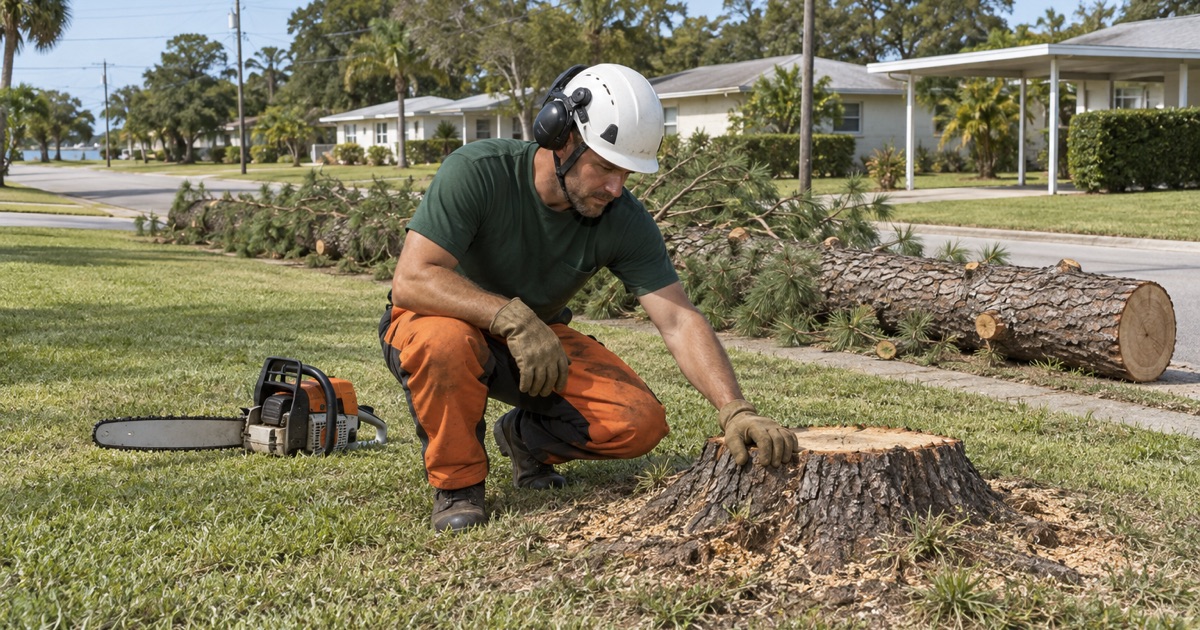
That sets an honest expectation for a below-grade cut. A stump grinder rated to roughly 20 inches will usually stop above the hardpan rather than cut through it, which is fine for restoring turf and worth knowing in advance if you plan to put a new tree in the same hole. It also explains why we watch the calendar in the wet season, since a machine working saturated sand over a hardpan leaves ruts that outlast the stump.
For owners who are not here year-round, every inspection comes back as written findings with photographs, so an assessment still means something when nobody is standing in the yard to hear it.
- 20+ Years on This Coast
- Written Estimates
- No Topping, No Hat Racking











