
Bradenton Tree Removal has been handling tree removal in Cortez for more than twenty years, on a shoreline where what you may cut and what you may plant back answer to two different authorities. We take down failing oaks and pines, grind stumps below grade, prune palms and hardwoods as the separate jobs they are, and clear storm wood off a property before it becomes somebody else’s problem. Every job opens with a written estimate that prices hauling and disposal on their own line, so the cost of moving the wood is visible instead of buried in a total.
Two conditions shape nearly every quote we write at an address here. Landscaping and fencing sit under a county overlay that protects views of the water, and mangrove work along the bay frontage is answered by the state rather than by the county. Both are covered below, because both change the order a job has to happen in.
We also say so plainly when a tree does not need to come down. When a cable, a root collar excavation with an air spade, or a season of directional pruning is the honest recommendation, that is what goes in the written condition report instead of a removal price. No topping, no hat racking and no hurricane cuts, on a hardwood or a palm, whoever asks for them.
Tree work in a working fishing village
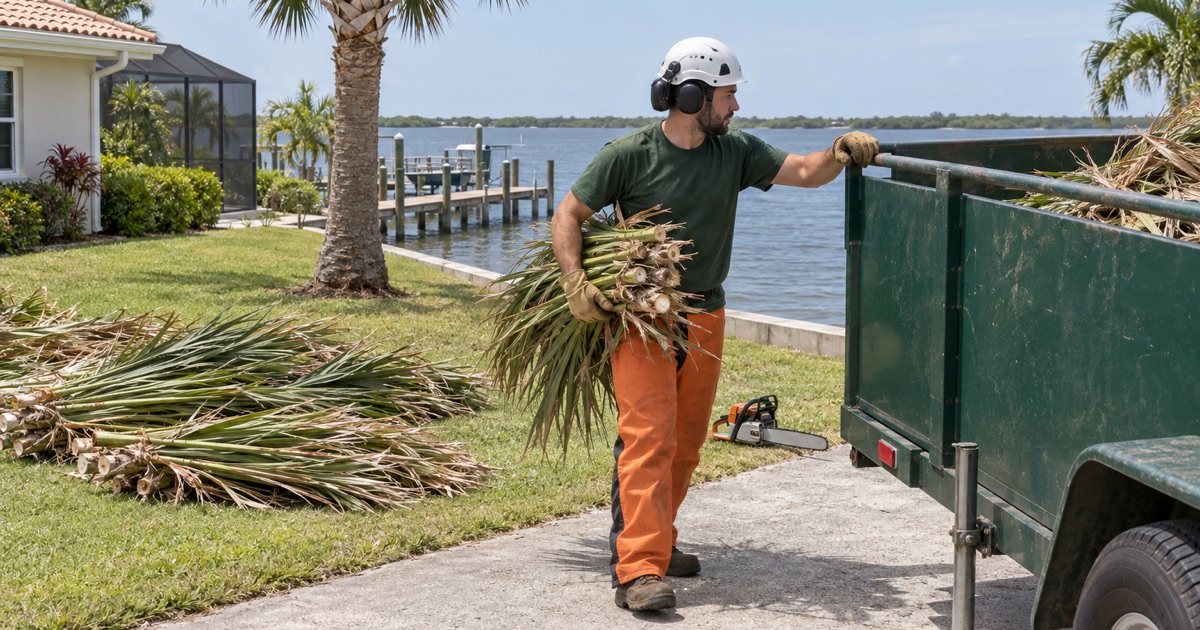
Cortez is an unincorporated census-designated place in Manatee County, a Gulf Coast commercial fishing village settled by North Carolina families in the 1880s, with a population of 4,121 at the 2020 census. There is no city hall to call. Manatee County answers every tree, permit and zoning question at a Cortez address through the Board of County Commissioners and the Development Services Department, whose Environmental Planning Section runs the Tree Removal Permit process that reaches common areas, commercial parcels and land an association maintains.
Removals here fall into two rough groups. There is the native canopy — live oak, laurel oak, slash pine, sabal palmetto, sea grape and gumbo limbo — and there is the invasive stock that keeps reappearing on disturbed coastal ground, Brazilian pepper, Australian pine, melaleuca and earleaf acacia. The second group is usually a clearing job rather than a tree job, and we price it as one.
Access on lots that end at the water
This place holds more water than land, 2.231 square miles of land against 2.882 square miles of water, and the parcels reflect it. Fish houses, docks and net camps sit tight against the bayfront, and a removal is often decided by what can physically reach the tree. We size access to the property, from a narrow-gate machine that fits through a fenced side yard to a crane pick that lifts wood out over a pool cage or a dock rather than dragging it across one.
Sand, hardpan and a shallow water table
Twenty years of grinding on this coast is mostly twenty years of learning what sits under the turf. The flatwoods sands here — EauGallie, Myakka and Wabasso fine sands — carry a spodic horizon, a cemented hardpan that keeps a root plate shallow and stops a grinder cold at an uneven depth. A seasonal high water table sits close enough to the surface that a below-grade stump cut can find standing water in the same hole. Storm surge salt inundation adds a second problem: a tree that looks intact after a surge event can decline months later, and that delayed mortality is worth a follow-up inspection rather than an immediate removal.
Palms and hardwoods are not the same job
A palm has no branch collar to cut back to, and a wound in the trunk never compartmentalizes the way a hardwood wound does. We prune sabal palms to the nine and three clock rule rather than stripping the frond skirt to a pencil point, because over-pruning a palm on a wind-exposed lot buys nothing and costs the tree its stored potassium. Ganoderma butt rot is the other common reason a palm here comes down: there is no treatment for Ganoderma zonatum, so a conk at the base of a trunk is a removal conversation rather than a pruning one. Lethal bronzing and spear leaf collapse get the same straight answer, which is what the symptom is and whether the tree can still be saved.
Looking for tree-removal closer to Longboat Key? See Tree-Removal Services in Longboat Key.
The overlay clause that governs what you may plant
The layer that actually reaches a landscaping or tree job in the village core is Manatee County Land Development Code section 403.5.I, the Cortez Fishing Village Historical and Archaeological Overlay District. It was established to preserve and protect the cultural heritage of the Cortez area, to recognize the continued use of the area by commercial fishing families, and to encourage the preservation and reuse of existing contributing historic structures. Its vegetation clause is unusually direct for a historic overlay: it prohibits privacy fencing and landscaping that block views of the water, or that negatively impact the open space character of Cortez.
That is a planting restriction rather than a design preference, and it changes what we can offer as a replacement. A homeowner three miles inland can answer a removal by putting in a fast privacy screen; a lot inside this overlay may not, and proposing one would create a problem with the county rather than solve one for the customer. When a removal opens a sightline, we say plainly that the replacement conversation here is about single specimens and canopy, not a hedge row.
The National Register listing is not a tree ordinance
The Cortez Commercial Fishing Village and the 1912 Cortez Rural Graded Schoolhouse are designated on the National Register of Historic Places, a listing the Cortez Village Historical Society worked to secure and that the Florida Maritime Museum sits inside. That designation is honorary. It does not by itself require a property owner to obtain a permit to remove a tree, and we do not treat it as though it does. The overlay section above is the layer with teeth, and confusing the two is the most common misunderstanding we hear at an address in the village.
What the overlay adds to an estimate
An estimate inside the district carries one extra step. We confirm which parcel lines fall inside section 403.5.I before pricing any replacement planting or screening work, and we route anything that touches the district’s open character through Development Services rather than assuming an ordinary residential answer applies. None of that costs the customer time when it happens before a crew is scheduled, which is exactly why it happens at the estimate.
Mangrove trimming on this shoreline is a state permit
Mangroves along a Cortez waterfront are governed by the Mangrove Trimming and Preservation Act, Florida Statutes sections 403.9321 through 403.9333, administered by the Florida Department of Environmental Protection. The Act allows the department to delegate that authority to a local government, and its published list of delegated local governments names Miami-Dade, Broward, Hillsborough and Pinellas counties, the Town of Jupiter Island, the City of Sanibel and Sarasota County. Manatee County is not on it. The county states the same thing in its own words: Manatee County has not been granted delegated authority by the department, and mangrove areas are therefore regulated as any other wetland area in the county.
So mangrove work on Sarasota Bay frontage here goes to the state, and starting that conversation at the county counter is a way to lose a month. The contrast is sharp at the county line, because the identical species of work at a waterfront address in Sarasota County, immediately south, runs through a delegated local program instead. Where the Act’s general permits apply, they route certain trims through a professional mangrove trimmer as the statute defines that term, and the trim is measured against the Act’s own limits rather than against an ordinary pruning specification.
The residential exemption stops at the mangrove line
The state’s residential tree exemption is no help on this shoreline either. Florida Statutes section 163.045(4) expressly excludes mangroves, so the documented risk letter that lets a homeowner remove a hazardous hardwood without a local permit never reaches a mangrove trim. Manatee County publishes the same carve-out, stating that the bill does not apply to mangrove trees, whose trimming and alteration is regulated statewide by the Florida Department of Environmental Protection. If a bid you are handed treats a mangrove line as ordinary shoreline pruning, that is the first thing to ask about.
Florida Statutes section 163.045 across a mixed housing stock
For everything that is not a mangrove, Florida Statutes section 163.045 is the rule most owners here have heard of. It bars a local government from requiring a permit, an application fee or mitigation to remove a tree on residential property when a certified arborist or a Florida-licensed landscape architect documents that the tree presents an unacceptable risk. Its reach is narrower than the summaries suggest, because it applies to a single-family detached building on a lot actively used for single-family residential purposes and to nothing else.
That distinction matters more in Cortez than it does in a conventional subdivision. Of 4,073 housing units here, 1,219 are mobile homes, close to thirty percent of the stock and a category the statute does not reach at all, with a further share attached or in multi-unit buildings and only 1,073 owner-occupied one-unit detached units in the whole place. We tell an owner which side of that line the property sits on before the risk-documentation conversation starts, because on the far side of it the county process is the only path.
Street trees and the 30-day replacement rule
Away from the statute, the county’s residential guidance is straightforward. No permit is needed to remove a tree in a private back or side yard on an occupied single-family lot; the trigger is a street tree, within 25 feet of the right of way in a residential development approved after October 15, 1990. Remove one without documentation from an ISA-certified arborist or a Florida-licensed landscape architect and it must be replaced within 30 days, planted within 25 feet back from the right of way, graded Florida number 1. Manatee County does not require a permit to replace a required street tree, which is worth knowing before anyone pays for one.
Hauling, power lines and the fire district
Much of the canopy here grows under overhead lines owned by Florida Power & Light, and a removal beside an energized primary is scheduled around the utility rather than around the crew. Horticultural debris leaves the site under the Manatee County Utilities Department’s Solid Waste Division rules for unincorporated collection, at a contractor gate rate rather than a household one, which is precisely why our estimates carry disposal as its own line. Fire service is West Manatee Fire Rescue District, an independent special fire control district rather than a county or municipal department, with Station 2 at 10350 Cortez Road inside the village.
Seasonal owners and the written record
A large share of the housing here is held for seasonal or occasional use, which means a fair number of the trees we assess belong to somebody who is not in the state on the day we assess them. Those owners get written findings and photographs, so an inspection still means something with nobody standing in the yard. We work removals and pruning to ANSI A300, run the crew under ANSI Z133, and write a removal recommendation against the ISA Best Management Practices Tree Risk Assessment, Second Edition 2017, so the reasoning is on the record before a saw starts. Storm-season work is better booked before the season than scrambled after it, and on a waterfront this exposed that is a matter of availability rather than preference.
- 20+ Years on This Coast
- Written Estimates
- No Topping, No Hat Racking











