
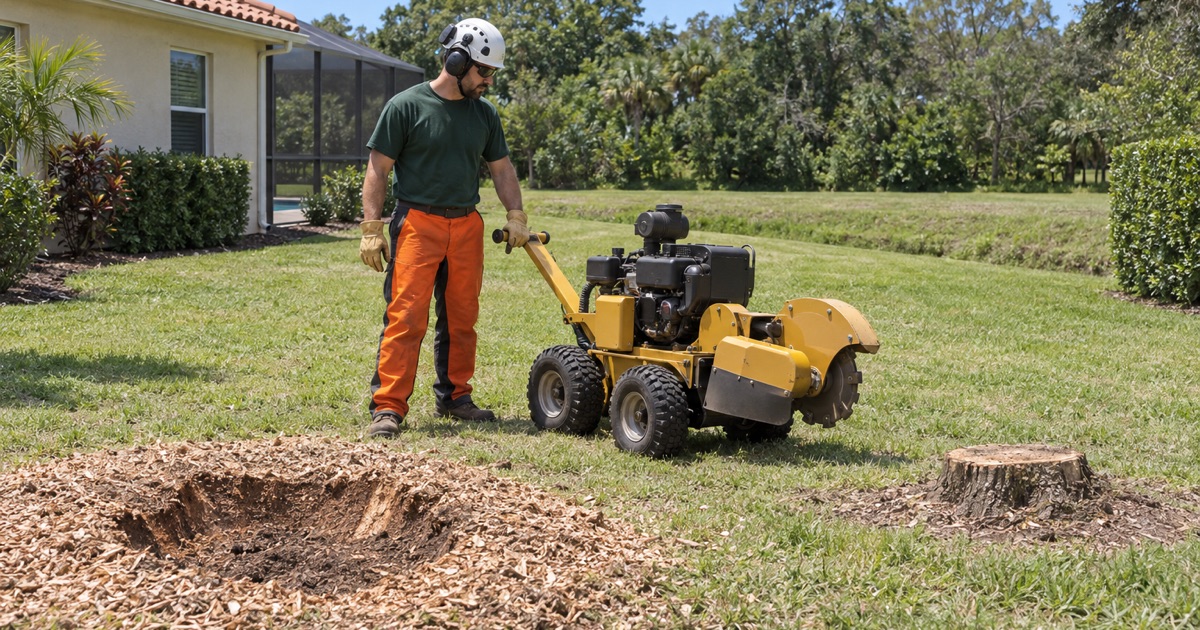
Bradenton Tree Removal has spent more than twenty years doing tree removal in Fruitville and along this stretch of the Gulf coast, where a stump grinder meets sand, a cemented hardpan and a high water table instead of soil over rock. We take down hardwoods and palms, grind the stump below grade, and get the wood off the property the same day the crew is on it. What that costs is written down before a saw runs, with hauling and disposal on their own line rather than folded into a single number.
Most of what we are called out for here is not an emergency. It is a tree planted with the house that has outgrown the spot it was put in: a laurel oak leaning over a screen enclosure, co-dominant stems with included bark at the union, a sabal palm over-trimmed for years. When cabling and bracing, a root collar excavation with an air spade, or a season of directional pruning is the honest answer, that is what the written condition report says instead of a removal price.
Access decides much of the rest. We size the machine to the property before quoting, from a narrow-gate rig that fits a fenced side yard to a crane pick over a pool cage, and we do not top, hat rack or hurricane cut anything, whoever asks for it.
What a 1923 drainage district left under the yard
Fruitville is a census-designated place in Sarasota County rather than a city of its own, and it was farm country within living memory. A drainage district formed in 1923 converted roughly 8,000 acres of wetland into farmland, celery became the major crop, and by 1966 an estimated 2,000 migrant workers in Sarasota County supplied much of the labor that worked it. The subdivisions came afterward, laid over ground that had already been cut with canals and ditches.
The Celery Fields are stormwater, not scenery
The clearest surviving piece of that system sits about a mile southeast of the Interstate 75 and Fruitville Road interchange: 440 acres of open marshland, ponds and canals that the county operates as stormwater infrastructure, edged with oaks, willows and pines and crossed by two public boardwalks, one on Palmer Boulevard and one on Raymond Road. Sarasota Audubon has surveyed birds there since early 2001 and has recorded 246 species. It is a working drainage facility, and what it tells a tree crew is how much of the water on this ground is managed rather than natural.
Engineered ground does not always read like the soil map
The mapped soil across this area is Map Unit 10, EauGallie and Myakka fine sands, and the EauGallie series puts a cemented spodic horizon at 22 to 35 inches below the surface. The same series is described as very poorly to poorly drained, with the water table rising to within 6 to 18 inches of the surface for one to four months of the year and sitting within 40 inches for more than six months of it.
A stump grinder’s rated below-grade cut commonly runs 12 to 25 inches, which puts that pan at the deep end of ordinary machine range rather than safely past it; whether the hardpan or the machine’s own rated depth stops the work first is a question about the specific machine. We also do not assume the survey describes every parcel here identically. Ground the drainage district cut, or ground the county graded when it built its retention cells, can behave differently underfoot than a typical soil profile implies, and that is better found at the estimate than with a grinder already in the hole.
Looking for tree-removal closer to Siesta Key? See Tree-Removal in Siesta Key.
A canopy that all went in at the same time
The housing stock here is unusually concentrated in age: of 7,868 units, 2,759 went up between 1980 and 1989 and another 1,751 between 1990 and 1999, which is 70.0 percent of everything standing. Just 1,191 units predate 1980.
That matters more than it sounds. Trees planted with a house in the late 1980s are structurally mature now, old enough to have put a root plate under a driveway and a crown over a roof line, and young enough that nobody on the street has had to make a decision about them yet. Where the houses went in together, the trees tend to arrive at that decision together as well.
The failures this age of tree brings
The two we find most often are the ones planted for quick shade. Laurel oak holds a convincing canopy while the trunk hollows out behind it, and paired co-dominant stems with included bark at the union are a splitting failure waiting on the right gust. Neither one announces itself from the curb, which is why we start at the root flare rather than the crown.
Palms are a different trade
A palm has no branch collar to cut back to and never compartmentalizes a trunk wound the way an oak does, so we quote and work them as the separate job they are. We prune sabal palms to the nine and three clock rule rather than shaving the frond skirt to a pencil point, because stripping green fronds off a palm on an exposed lot costs it stored potassium and buys nothing in return. Ganoderma butt rot is the usual reason one comes out here: a conk low on the trunk means Ganoderma zonatum, there is no treatment for it, and the root plate comes out with the stem.
Who signs off on a tree at a Fruitville address
The mail here reads Sarasota, which is a postal convention rather than a jurisdiction. This is an unincorporated community, so the City of Sarasota’s own zoning and tree provisions do not reach a lot in Fruitville; Sarasota County government answers every tree, clearing and code question at an address here.
Chapter 54, Article XVIII
The code that applies is the Sarasota County Code of Ordinances, Chapter 54, Article XVIII, Trees, with permitting criteria and procedures at section 54-586 as amended by Ordinance 2008-041. It requires a tree permit before any construction activity or removal of native vegetation within the dripline of a tree on any lot, and it directs that development applications submitted after 30 October 2002 be designed to protect grand trees, with exceptions only for safety or where setting aside that space would unreasonably prevent development of the lot. Anything tied to construction, subdivision or site-plan activity is reviewed under Chapter 74, the county’s Land Development Regulations.
Because this area platted out in the 1980s and 1990s, most of what stands here went up before that 2002 design-protection date. It is the new building permit or the major renovation on an older lot with mature trees that pulls the duty in, not the original subdivision.
What makes a tree a grand tree
Grand tree status is not a diameter you can eyeball. The county scores it on points, a species schedule plus a second schedule for diameter at breast height, height and crown spread, and the tree also has to carry a condition classification of 70 percent or better to qualify. We measure and score before quoting, because a tree that scores in changes the sequence of a job rather than just its price.
Florida Statutes section 163.045, and the stock it misses
The statute bars a local government from requiring notice, an application, a permit, a fee or mitigation to prune or remove a tree on a single-family detached building on a lot in active single-family residential use, where the owner holds signed documentation from an arborist certified by the International Society of Arboriculture, or from a Florida-licensed landscape architect, that the tree poses an unacceptable risk to persons or property. No replanting may be required, and that documentation is written against the ISA Best Management Practices Tree Risk Assessment Second Edition 2017.
Its reach here is narrower than people assume: the class it describes, a single-family detached building actually used as one, covers 46.9 percent of the housing units in this community, while about 21 percent sit in buildings of twenty units or more that it does not touch at all. It also does not reach a vacant lot, or a parcel still carrying an agricultural classification with the county property appraiser.
That last carve-out is not theoretical on ground with this history. The county’s own exemptions cover Florida Exotic Pest Plant Council Category I invasive species, emergency work by government personnel, and removal for agricultural or silvicultural purposes on land the property appraiser classifies as agricultural. We hold that provision as a search-indexed excerpt rather than as text pulled from the county’s own document, so we confirm it against the current code before anyone leans on it.
Florida issues no state tree or arborist contractor license, and Florida Statutes section 163.211 preempts local licensing of the trade. What that leaves a homeowner to judge is the written record: a condition report naming the defect and the standard it was assessed against, before a saw starts.
Getting the wood off the lot, and when to book the work
Debris is the line item most estimates bury. The county’s solid waste code defines yard trash as vegetative matter resulting from landscaping maintenance and land clearing operations, including the rocks and soils that come with it, but it excludes material collected by a commercial lawn service from the residential program. In practice that means what a tree crew cuts does not go to your curb; it leaves on our trucks and is weighed and paid for at the Central County Solid Waste Disposal Complex in Nokomis.
Which is why hauling and disposal sit on their own line in the written estimate. A mature live oak makes far more volume than a driveway’s worth of imagination allows for, and a horticultural waste gate rate plus a contractor disposal surcharge is a real number rather than a rounding error.
Lines overhead, and rules that change at a county line
Florida Power and Light owns the overhead right of way above most of the canopy along these streets. The utility puts the responsibility on the customer to have a qualified tree trimmer handle anything within 10 feet of a power line, performs directional pruning that removes entire branches and limbs up to the main trunk, and collects the debris from its own work before the end of the next day except during restoration after a storm. We will tell you which side of that line your tree falls on.
We work across Manatee, Sarasota, Pinellas and Hillsborough counties, and the rules genuinely change when you cross those lines. An address in Fruitville answers to Sarasota County’s code, and we would rather tell you which rulebook governs your parcel than repeat what happened to be true on a job twenty miles north.
Storm season, and the owner who is not in the yard
Hurricane Milton came ashore near Siesta Key in Sarasota County on 9 October 2024 as a Category 3 storm with maximum sustained winds of 120 mph, and the Tampa Bay Area forecast office recorded 60 knots sustained with an 89 knot gust at Sarasota-Bradenton International Airport. No report from that storm carries any figure for tree damage, and we will not invent one. What a season like that argues for is booking removals and structural pruning ahead of it rather than joining the queue behind it, while crews and disposal capacity are both still easy to reach.
A fair share of the units here are not occupied year round, and some of the trees we assess belong to someone out of state on the day we assess them. Those owners get written findings and photographs, so an inspection still means something with nobody standing in the yard. Our removals and pruning follow ANSI A300, our crews work to ANSI Z133, and nothing here gets topped or hat racked because it would make a schedule easier.
- 20+ Years on This Coast
- Written Estimates
- No Topping, No Hat Racking











