
Bradenton Tree Removal handles tree removal in Gibsonton, where the first question on a job is almost never whether a tree can come down. It is which office has to agree first, and how far the trunk stands from the water. Twenty-plus years of tree work on this coast, where a grinder meets sand, hardpan and a water table rather than soil over rock, is most of what lets us answer that before we quote.
Every job starts with a written estimate, with hauling and disposal on their own line so you can see what moving the wood actually costs instead of finding it folded into the price of cutting. When we recommend taking a tree down, that recommendation arrives with a written condition report, so the reasoning is on the record before a saw starts.
We treat palms and hardwoods as the different jobs they are, since a palm has no branch collar to cut back to and a crew that has only ever worked oaks will ruin a sabal palmetto trying. Access gets sized to the property rather than the other way around, from a narrow-gate machine in a fenced back yard to a crane pick over a pool cage. We do not top, hat rack or hurricane cut anything, on any tree or any palm, whoever asks for it.
The Alafia River comes with its own removal line
Hillsborough County’s Residential Tree Removal Guide carries a note most homeowners never reach: when trees are located within 100 feet of the Hillsborough River, Palm River, Little Manatee River or Alafia River, removal may be prohibited per Hillsborough County Land Development Code 04.01.06. The Alafia runs directly through this community on its way to the bay, which puts a band of local back yards inside a restriction most of the county never has to think about. It does not scale with the size of the tree, and it is not something a contractor can quote around.
So the tape measure comes out before the estimate does. We record the distance from the trunk to the river, note the species and the diameter at breast height, and take that to the county’s Development Services Department, Natural Resources Section rather than guessing from a satellite image. On a riverfront lot the permit conversation is the critical path of the whole job, and treating it as paperwork to sort out later is how a crew ends up standing in a yard with nothing to do.
Away from that band the ordinary countywide machinery applies here as it does anywhere in unincorporated Hillsborough: a permit-threshold chart keyed to trunk size, an exempt-species list, and a point system that protects a grand oak on its own terms. Those are routine and we handle them as routine. The river setback is the part of this address that is genuinely its own.
When the honest answer is a prune rather than a removal
The 100-foot line changes what a good recommendation looks like. A leaning laurel oak thirty feet off the water can be a candidate for directional pruning under ANSI A300, or for cabling and bracing at a pair of co-dominant stems with included bark, where the same tree on an inland lot would simply come out. We would rather write that up and stand behind it than sell a removal the county was never going to approve.
Mangroves are somebody else’s permit entirely
Where a job reaches shoreline growth on the river or the bay frontage, mangroves sit outside the tree ordinance: the Environmental Protection Commission of Hillsborough County holds the state’s delegated authority for mangrove trimming under Florida Statutes section 403.9324, and the Mangrove Trimming and Preservation Act sets what a professional mangrove trimmer may do. No arborist report converts that into work we can perform on our own say-so. The Southwest Florida Water Management District’s jurisdiction over the Alafia corridor is a third layer worth checking before anything near the bank is touched.
Looking for tree-removal closer to Nokomis? See Tree-Removal Services in Nokomis.
A working port on one side of the road, back yards on the other
The waterfront here is industrial in a way that changes how a tree job gets scoped. CSX operates its Rockport Terminals as deep-water port facilities on Tampa Bay, described as more than 300 acres with over 25 miles of track, warehousing and loading systems built to export phosphate out of Central Florida’s Bone Valley mining region. Port Redwing, a Port of Tampa Bay facility near this community, is planned with a rail connection to CSX mainline track and roadway connections toward Interstate 4 and the Lee Roy Selmon Expressway.
Practically, that means the first thing we settle near the corridor is who owns the ground the tree is standing on. A tree inside a terminal fence or over an active rail right of way is not a residential permit question at all, because the railroad runs its own vegetation clearance on its own schedule. A homeowner whose back line touches that ground is asking about work we cannot sell them, and we would rather say so on the phone than on the invoice.
Staging on a freight route
US Highway 41 runs through the center of the community and carries the traffic you would expect of a road serving a port. Setting a crane or a chipper anywhere near it is a planning problem before it is a rigging problem, so the drop zone, the truck position and the traffic control all go into the written estimate rather than getting worked out on the morning. ANSI Z133 governs how that zone is kept and who stands where inside it.
Salt, wind and what the bay leaves behind
Bay-adjacent lots take storm surge salt inundation that lots a few miles inland do not, and delayed post-storm mortality is why a tree that looked survivable in the fall can be a genuine hazard by spring. We book storm-season work before the season rather than scrambling after it. Where a tree sits on the line we document it against the ISA Best Management Practices Tree Risk Assessment, Second Edition 2017, and come back to look again rather than talking anyone into a removal on one visit.
Who the state exemption actually reaches in a mobile-home town
Florida Statutes section 163.045 is the pathway homeowners hear about, the documented-dangerous-tree route that sets the county permit requirement aside, and its reach is narrower than its reputation. It applies to a single-family detached building on a lot used for single-family residential purposes. That wording carries real weight in a community where mobile homes account for 1,846 of 6,739 housing units, or 27.4 percent, the largest share anywhere we work in this part of the county.
A mobile home is not a single-family detached building for the purpose of that statute, and a resident who owns the coach but rents the ground under it stands further outside it again. Owner-occupancy here runs 69.6 percent, the lowest of the communities in this ring, so the gap between what the statute covers and what people assume it covers is wider at this address than almost anywhere nearby. The county’s own guide does not help, since it still labels the pathway by the 2019 bill that preceded the current statute. None of that makes a removal impossible; it makes the permit route the default rather than the exception.
What that changes about how we quote
We treat a job here as permit-required until the Natural Resources Section says otherwise, and the estimate says as much in plain words. If your address does qualify for the documented pathway, nothing has been lost, because the condition report and the measurements are already assembled. If it does not, you have not paid for a crew to arrive on a day the work could not lawfully happen.
Who can actually authorize the removal
On a rented lot the person with the tree problem is often not the person who can approve taking the tree out. We ask for that in writing early, because a land owner, a park operator and a resident can each give a different answer, and agreement from the wrong one is not consent. Owners who are away for part of the year get the same care in reverse: written findings and photographs, so an inspection still means something when nobody is standing in the yard.
Ground that argues back, and a disposal gate inside the community
The soil under this community maps as Myakka fine sand, poorly drained, hydrologic group A/D, with a spodic horizon that typically sits roughly 20 to 36 inches below grade. A stump grinder below-grade cut behaves differently over that hardpan than it does over free-draining sand, and a root plate that spread sideways because it could not go down is why some failures here look like a whole tree tipping rather than a trunk breaking. The county’s engineering suitability rating for this soil at this location flags dwellings without basements, septic tank absorption fields and local roads as very limited, which is also a fair description of what a loaded truck does to a soft yard in the wet season.
Hauling to a gate that is already here
Most of our work involves a drive to reach a legal gate. This community hosts one: the South County Solid Waste Facility at 13000 US Highway 41, open Monday through Saturday, taking yard and wood waste including brush, grass clippings, leaves, tree and shrub trimmings and untreated wood, with a free mulch pick-up program for residents.
Curbside is not the alternative it looks like. The county excludes landscaping and tree trimming providers from residential folio collection, so a contractor’s wood goes through the commercial gate at the horticultural waste gate rate whatever the pile looks like. That charge shows up as its own line on your estimate rather than disappearing into a lump sum, which is the only way you can judge whether the number is fair.
Palms are their own decision
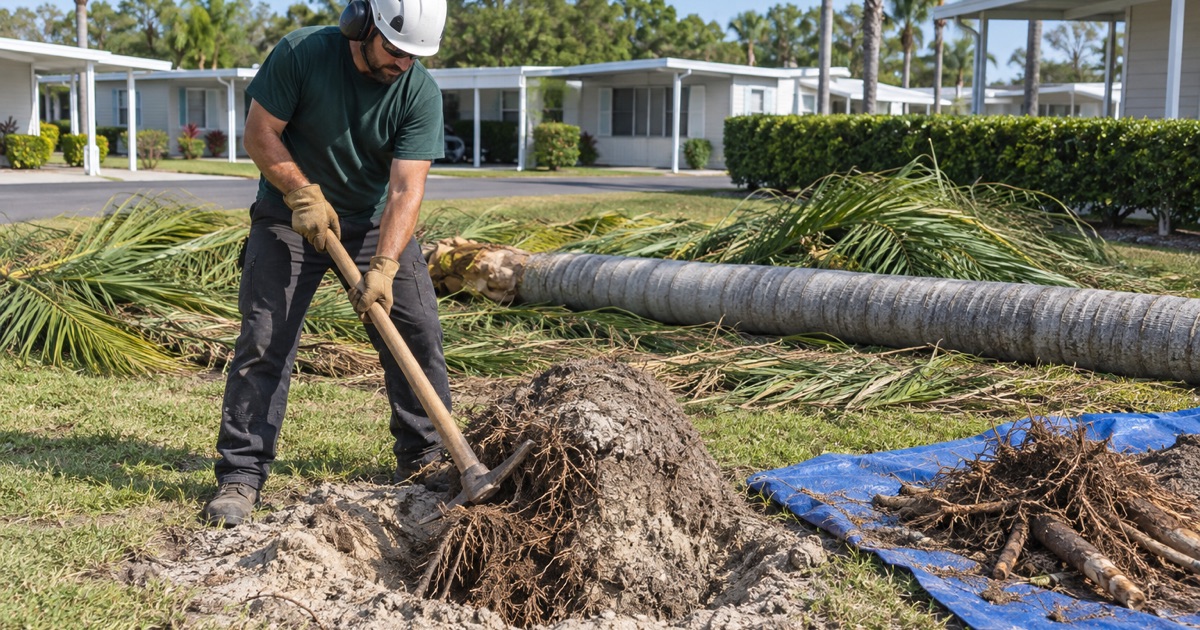
Coastal lots here carry palms that get diagnosed casually and removed unnecessarily. Ganoderma butt rot is not treatable and the tree has to go; potassium deficiency looks alarming and does not call for a saw at all. We prune to the nine and three clock rule, leave the frond skirt where the species is not self-cleaning, and treat a spear leaf collapse as a reason to investigate rather than a verdict.
A canopy planted across six decades
Houses here went up in every decade back to the 1940s rather than in one subdivision build-out, and the trees reflect that. A single street can hold a mature live oak whose root collar is buried under decades of added grade, a slash pine left over from the flatwoods, and a Brazilian pepper nobody planted deliberately. We use root collar excavation with an air spade where a buried collar is the real problem, and we will tell you plainly when a tree does not need to come down at all.
- 20+ Years on This Coast
- Written Estimates
- No Topping, No Hat Racking











