
Bradenton Tree Removal has spent more than twenty years doing tree removal in Lakewood Ranch, and the first question we answer at an address here is rarely a county one. The tree usually sits under a community development district’s authority, under a village declaration, or under both, and that is who has to be satisfied before a saw runs. We take the tree down, grind the stump below grade and haul the wood off the property, and we tell you plainly which approval chain your address is actually on.
Every job is quoted in writing first, with hauling and disposal carrying their own line on that estimate so the cost of moving the wood is never buried inside the price of the cut. Palms and hardwoods are crewed as the separate jobs they are, because a palm has no branch collar to cut to and a hardwood crew working one like an oak leaves wounds that never close. We do not top, hat rack or hurricane cut anything, on any tree or any palm, whoever asks for it.
Access here is usually a gate width and a lawn rather than a boom length, and we settle that in the estimate rather than on the morning of the job. When a tree does not need to come down we put that in writing too, with the reasoning on the record before anyone climbs.
The district and the declaration come first
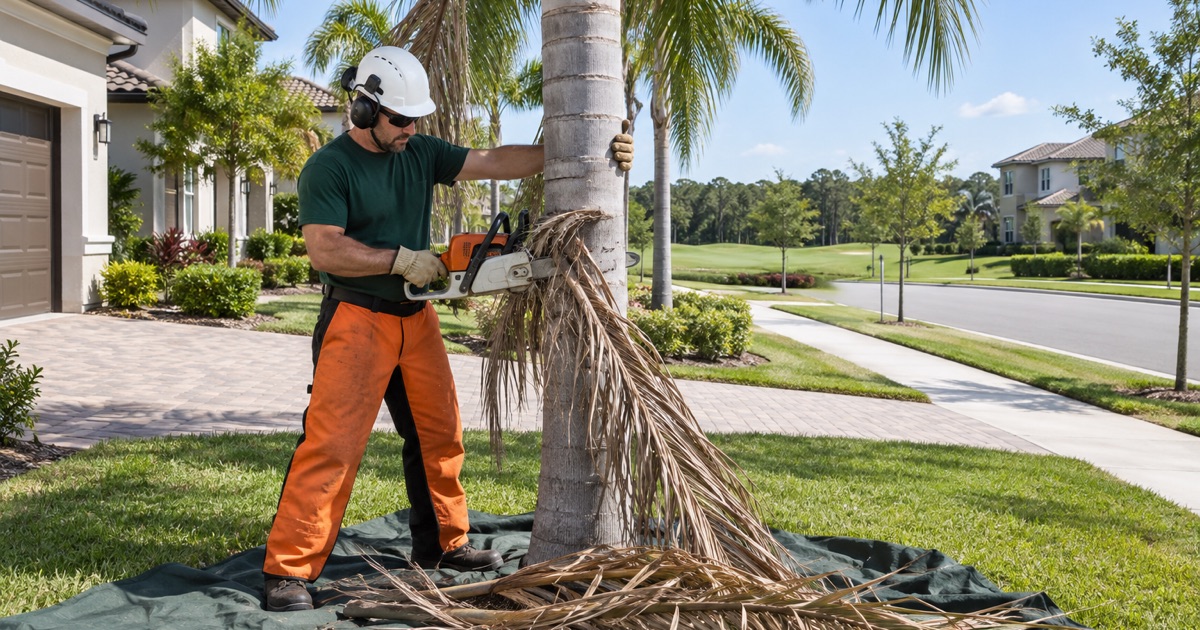
Lakewood Ranch is a planned community rather than a municipality, so there is no city hall to call about a tree. Manatee County Development Services answers the underlying land-development question at an address on the northern side of the community, and Sarasota County answers it in the southern villages around Waterside. Neither of those offices is usually the one that decides what happens to your tree.
Five districts in Phase I, and more after it
The community’s own resident materials name them without ambiguity: there are five community development districts in Lakewood Ranch Phase I, CDD1, CDD2, CDD4, CDD5 and CDD6, each governed by a five-member board. These are special-purpose local governments created under Chapter 190 of the Florida Statutes, and the community’s own portal describes a district’s powers as planning, financing, constructing, operating and maintaining community-wide infrastructure and services. Streetscape trees, entry-feature plantings and common-area landscaping sit squarely inside that description. Later phases carry districts of their own, and Windward at Lakewood Ranch Community Development District, on the Sarasota County side, describes itself in the same Chapter 190 terms.
What is confirmed is the roster and the general powers, not one tree rule running identically across all of them. Districts differ, boards differ, and the operative instrument on a particular street can be a district’s own policy or the plat the village was built under. We ask which district a property sits in before we quote, and we would rather make that call than assume it.
The declaration recorded against your village
Sitting alongside the district is a private layer: the homeowner or condominium declaration recorded against the village a house is in. That is a contract among owners rather than an ordinance, and it commonly reaches the trees on an individual platted lot, covering what may be taken out, what has to go back, and sometimes what species is acceptable in the replacement. An architectural review committee can decline a removal a county would never have asked a question about. We work to whatever the declaration requires, and we will read the tree provisions with you when the answer is not obvious.
The written condition report we produce on any tree we recommend taking down is frequently the document that moves that application forward. A board reading a defect described in the language of the ISA Best Management Practices Tree Risk Assessment Second Edition 2017, with diameter at breast height and the defect’s location recorded, has something in front of it to act on. A phone call describing a tree as looking bad does not.
Looking for tree-removal closer to Fruitville? See Fruitville Tree-Removal.
Where Florida Statutes section 163.045 stops
The state’s residential tree exemption is real and it does apply at an address in this community. For a single-family detached building on a lot in active single-family residential use, where the owner holds documentation from an arborist certified by the International Society of Arboriculture or a Florida-licensed landscape architect that the tree presents a danger, a local government may not require notice, application, approval, permit, fee or mitigation to prune, trim or remove it, and no replanting may be required afterward.
What the statute preempts is a local government
The word doing the work in that statute is government: it reaches a county’s or a city’s permitting of a homeowner’s own tree. A community development district’s authority over its own common-area, right-of-way and easement trees is not that, and a private covenant between owners is not that either. So the exemption can be squarely on your side at the county counter and change nothing at all about what your district or your association expects of you.
That distinction is the most useful thing to understand before starting a removal here, and it is the one we spend the most time explaining. The housing stock is overwhelmingly single-family detached, so the statute’s subject matter fits a great many of these lots. The layer it does not reach is precisely the layer that governs them.
The county code underneath all of it
Manatee County’s Land Development Code applies in the background at a northern address here exactly as it would anywhere else in the unincorporated county, and Sarasota County’s code does the same job in the southern villages. That background rule simply matters less on this ground than the district and the association do, which is not true of most of the places we work. It is still the first thing we check when a property sits outside a district boundary or on a parcel that predates a village’s declaration.
No state credential to point at
Florida issues no statewide tree or arborist contractor credential, and Florida Statutes section 163.211 preempts local occupational licensing, so there is no state card that settles who is competent to take down your oak. What we put forward instead is on paper: a written condition report, a written estimate, pruning cuts made to ANSI A300 and climbing and rigging done to ANSI Z133. Judge a crew on the documents it produces and the standards it names, because in this state there is very little else to judge one on.
Engineered fill, compacted subgrade and a young root plate
The ground under this community is not an intact native soil profile. It was cleared, graded, filled and compacted before the first house went up, and the lake system that shapes so much of the site plan is engineered stormwater rather than natural pond. A stump grinder meets imported fill and compacted subgrade here instead of the sand-over-hardpan sequence the county soil survey describes on undisturbed flatwoods ground a few miles away.
That changes a working day in small and expensive ways. Compacted subgrade takes a wheel differently than loose sand, spoil from a below-grade cut packs heavier and denser than the loose grindings a sandy lot throws, and irrigation and low-voltage lines installed with the landscape package run through exactly the ground the stump occupies. We locate what is buried before we grind rather than after.
Roots that were never given anywhere to go
Root systems on this ground are young and actively growing, and they have mostly been growing inside the loose, irrigated planting pocket a builder left rather than out into compacted fill. A root collar excavation with an air spade tells us what is actually happening down there, and on a tree this young the finding is often correctable: a girdling root, a basket left on at planting, a root collar set too deep from the day it went in. That is a different conversation from a removal and we would rather have it. Soil decompaction around a root plate buys a tree years on ground built like this.
Access is a gate, not a boom
Crane capacity is not usually the binding constraint in these villages the way it is on an older street elsewhere in the county. Trees this size come down without a pick more often than not, and the real question is whether a machine can reach a back yard through a village gate and across an irrigated lawn without leaving ruts a homeowner is still looking at in the dry season. Where a crane genuinely is the right answer, over a pool cage or a screen enclosure with no route around it, we say so in the estimate and price the street setup with it. We measure the gate and read the turf before quoting, and we bring the narrow-gate machine when that is what the property takes.
A canopy planted with the houses, and where the wood goes
About 68.4 percent of the housing here was built in 2010 or later, and just 1.36 percent of it predates 1980. Practically every tree we are asked to look at therefore went into the ground as part of a builder’s landscape package within the last one to fifteen years. That is unusual for this coast and it changes the work: spacing was decided by a plan rather than by time, and the defects we find are installation defects far more often than they are age.
What a landscape package leaves behind
The species list is short and repetitive because it was specified rather than inherited: live oak and laurel oak in turf islands and back yards, sabal palmetto along drives and entries, slash pine held over where a stand was left standing. Laurel oak is the one that misleads people, holding a full crown while the trunk hollows out behind it. On palms, Ganoderma zonatum shows as a conk low on the trunk, there is no treatment for it, and the palm and its root plate come out together. Lethal bronzing and spear leaf collapse are the other two we get called on, and both are removal conversations rather than pruning ones.
Co-dominant stems on a tree still young enough to fix
A tree planted in this community’s first building years with co-dominant stems and included bark is at the age where the decision costs very little. Directional pruning now, or cabling and bracing on a stem union worth keeping, is frequently the honest recommendation instead of a removal, and we will say so even when it is the smaller job. What we will not do is top a tree to shorten the argument.
Hauling, and the season to book it in
Disposal is the line item people underestimate, which is why it sits on its own line rather than disappearing into the cut. A horticultural waste gate rate and a contractor disposal surcharge are real numbers, and a removal makes far more volume than a driveway’s worth of imagination allows for. Work on common ground adds a wrinkle worth settling early, because material leaving district or association property has to leave in a manner the district is content with, and we agree that before the trucks arrive.
Storm season is the other reason to have this conversation ahead of time. We book removals and reduction work before the season rather than in the queue behind one, and delayed post-storm mortality means a tree that looked survivable in September is sometimes the one we are called back to in January. The overhead distribution line over most of these streets belongs to Florida Power and Light, and anything inside the clearance of a primary conductor is the utility’s call before it is ours. For an owner who is not here year round, and a good share of these homes are held for seasonal or occasional use, we send written findings and photographs so an inspection still means something when nobody is standing in the yard.
- 20+ Years on This Coast
- Written Estimates
- No Topping, No Hat Racking











