
Bradenton Tree Removal begins a tree removal in Madeira Beach at a counter most owners never expect to visit, because the city’s permit for an ordinary tree carries no fee at all and still has a genuine application behind it. Free is not the same as automatic. We settle what the address actually requires, and who has to sign it, before a truck is loaded.
Everything is priced in writing before anything is cut, with hauling and disposal set out as their own line rather than buried inside one number, because on a barrier island moving the wood is frequently the larger half of the job. Palms and hardwoods go out as the two different jobs they are, with crews who know a palm has no branch collar to cut to and rewards none of the habits a hardwood teaches.
Twenty-plus years of tree work on this coast is mostly twenty years of grinders meeting sand and a water table rather than soil over rock. Cuts follow ANSI A300 practice, we do not top, hat rack or hurricane cut anything for anyone, and where pruning or a cable is the honest recommendation that is what lands on the estimate instead of a removal. Any tree we do recommend taking down gets a written condition report first, so the reasoning is on the record before a saw starts.
A no-fee permit with a real application behind it
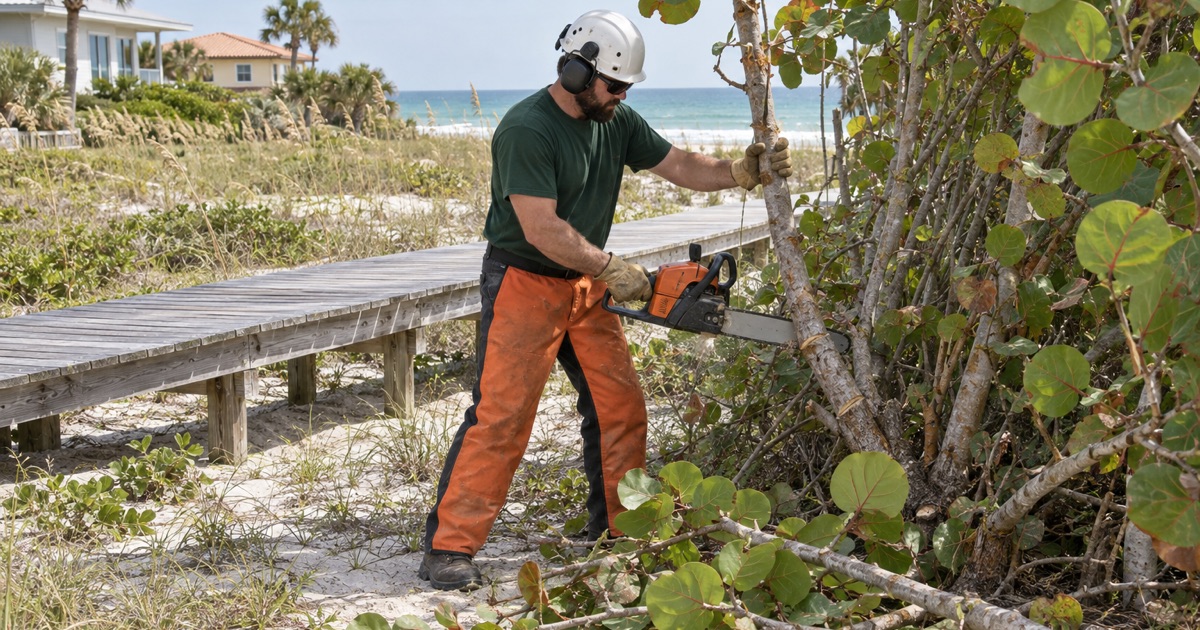
This is an incorporated Florida city with its own charter, city commission and building department, so a tree question at a city address is answered inside city hall rather than at a county desk. The Code of Ordinances puts the requirement in a single sentence at section 106-69: ‘It shall be unlawful for any person to remove or cause to be removed any tree having a diameter at breast height of four inches or greater without first having procured a no fee permit.’ The permit costs nothing, which is unusual enough that owners and out-of-town crews alike assume it therefore does not exist.
That assumption is the expensive one. A crew that skips a free permit has still removed a tree without a permit, and the city’s own code calls that removal unlawful. We pull it as a matter of course and show it on the estimate as a step we performed rather than as a cost we passed along.
Four inches, measured where the code measures it
Diameter at breast height is a defined measurement rather than a glance at a trunk, and four inches is a low bar. A sea grape or a sabal palmetto crosses it long before an owner would call the thing a mature tree, so we measure what is on the lot before quoting any of it. Multi-stem specimens and co-dominant stems get measured stem by stem and described that way on the application, not averaged into one convenient number.
The site plan that section 106-70 asks for
The application is not a form with a species and an address on it. Section 106-70 requires ‘a site plan showing the location of all trees and mangroves, the trees proposed to be removed, existing and proposed structures, walks, driveways and parking areas,’ which means the whole lot gets drawn before one tree can leave it. On a beach lot carrying a pool deck, a driveway apron and a seawall inside the same fifty feet, that drawing takes real time.
We produce it as part of the estimate rather than as an extra afterward. Locating every tree and mangrove on the property is also how the drop zones, the crane position and the machine access get settled, so the drawing the city wants and the drawing the crew needs turn out to be the same drawing.
Looking for tree-removal closer to Balm? See Balm Tree-Removal.
Three governments on one mangrove
The same section of code that hands out a free permit for an oak turns strict at the water line. It reads: ‘It shall be unlawful for any person to remove or cause to be removed any mangrove, regardless of size without first having procured the required city, county and state permits.’ Regardless of size is the operative phrase, and so is the plural — three separate governments, named in the city’s own ordinance, before a single mangrove comes out.
Plenty of beach cities on this coast simply defer to the county on mangroves. This one keeps a permit of its own stacked on top, which makes a mangrove removal here a longer job on paper than the identical removal under a different charter. We quote it as the multi-agency job it is, with the review time named on the estimate, instead of promising a start date that depends on three approvals nobody holds yet.
Where each of the three permits actually goes
The county layer is not a formality invented locally. Under a 1996 order of delegation from the Florida Department of Environmental Protection, Pinellas County is delegated the authority to issue permits for mangrove trimming within the entire territorial limits of the county, and that application goes to the Pinellas County Department of Environmental Management. The state’s own list of delegated local governments names the county and no individual municipality, so the city code’s ‘county’ permit routes there and its ‘state’ permit routes back to the Florida Department of Environmental Protection for whatever the delegation does not reach.
Inside the fringe itself the work belongs to a professional mangrove trimmer under the Mangrove Trimming and Preservation Act, and we say so plainly rather than take it on as ordinary tree work. Coastal Construction Control Line and sovereign submerged lands questions on a Gulf-front lot are a state matter as well.
The statute that does not rescue a mangrove
Florida Statutes section 163.045 is the route owners have usually heard about, and it is narrower than its reputation. It defines residential property as ‘a single-family, detached building located on a lot that is actively used for single-family residential purposes,’ and only inside that definition can documented arborist findings displace a local permit. Here that pool is 811 owner-occupied one-unit detached homes against 4,001 housing units in total, about 20.3 percent of the stock, with roughly a third of the stock sitting in buildings of twenty or more units and outside the statute regardless.
Subsection (4) of the same statute settles the mangrove question outright by excluding mangrove protections from its reach. No arborist letter, however thorough, turns a mangrove into a tree the state exemption covers, and we will not write one that implies otherwise. Our condition reports follow the ISA Best Management Practices Tree Risk Assessment framework in either case, because defect, target and the odds of failure are worth recording whether or not a statute is in play.
Ground that was dredged into place
The soil under a lot here is not a natural profile. A point query against the state’s own Florida SSURGO layer returns map unit 16, ‘Matlacha and St. Augustine soils and Urban land’ — an undifferentiated group in the Entisol order rather than the flatwoods sequence a mainland address would sit on. Its representative component, at 32 percent, is a series whose official description says it formed in fill material, the result of dredging and filling operations along peninsular Florida.
Why the grinder stops where it stops
That series is somewhat poorly drained, carrying a water table at depths of 20 to 30 inches for two to six months in most years. The binding constraint on a stump grinder below-grade cut here is therefore seasonal saturation rather than bedrock or the hardpan a spodic horizon puts under an inland lot. Wet fill throws a different spoil, cuts slower and leaves backfill that settles further afterward, so where a stump needs a second pass we schedule the second pass instead of calling the first one finished.
Fill also changes what is holding the tree up. A root plate in loose, saturated fill spreads wide and shallow, which means anchorage is poorer than the trunk suggests and the rigging has to assume less than the tree looks capable of taking. We plan the pull and the drop zone on that assumption on a still morning exactly as we would after a blow.
Access between the Gulf and Boca Ciega Bay
Lots run narrow from water to water, and Gulf Boulevard is the only spine the island has. A drop zone commonly sits between a pool cage, a seawall and a neighbor’s tile roof, and that geometry picks the machine before the tree does: a narrow-gate machine into a fenced rear yard, or a crane pick to lift a limb out over the cage rather than drag it through. Those measurements are taken in advance and written into the estimate, because the machine decision is a measurement rather than a judgment made from the cab.
John’s Pass Village, the marina and what the beach can see
The city’s southern edge is John’s Pass, and John’s Pass Village and Boardwalk sits on it beside a municipal marina and a working charter and commercial fishing fleet. Locals call the place Mad Beach, and the name itself comes from the Portuguese island of Madeira. That waterfront is a scheduling constraint for us rather than scenery — a chip truck staged near the Village in season is a chip truck that will not leave on time, so commercial work down there takes early starts and the residential streets take the middle of the day.
Fixtures that must not be visible from the beach
Property on the Gulf side answers a lighting rule the inland half of the city does not. The city states that ‘the point source of light or any reflective surface of the light fixture shall not be directly visible from the beach,’ with shielding and mounting requirements set out alongside it. A canopy is often part of how a property currently satisfies that, and taking the canopy out changes what the beach can see.
So we raise it before the work rather than after, and where a screening tree is coming down we say plainly that a fixture may need shielding or relocating to keep the property right. That is a lighting requirement and not a work-timing one; we found no rule here dictating when a tree may or may not be cut, and we are not going to invent one.
Owners who are not on the island
More than half the vacant housing here is held for seasonal, recreational or occasional use, 1,143 units out of 2,050, and the stock overall is concentrated in the 1950s and the 1970s. The person deciding on a removal is frequently in another state, and sometimes it is a manager holding a key.
Written findings and dated photographs come out of every inspection for that reason, and nothing goes on the schedule before the estimate has been read. A decision made from a thousand miles away should not depend on a phone call to explain what the photographs already show.
Where the wood goes
Curbside collection runs through the city’s franchise contract with Waste Pro, reachable on (727) 543-8154, and it is sized for a household’s clippings rather than for a mature hardwood. What comes off a removal travels as our load to the county disposal complex, which charges yard waste at the same per-ton rate it charges household garbage. That is why hauling and disposal is a line you can see and decide on: hauled off the island, or left cut to length in the yard for whoever wants it.
Duke Energy Florida owns the right of way overhead, and nobody on our crews works inside ten feet of an energized line, because that clearance belongs to a qualified line-clearance contractor and ANSI Z133 governs what happens below it. Where the service line to the house is in the way, Duke will de-energize it at no cost, which is worth arranging ahead of the crew rather than during.
- 20+ Years on This Coast
- Written Estimates
- No Topping, No Hat Racking











