
Bradenton Tree Removal handles mangrove trimming on waterfront property around Bradenton, and it is the most tightly regulated work on this site. It is included as its own service for a straightforward reason: almost nothing a property owner knows about tree permits applies to mangroves, and the assumptions that carry over from a back-yard oak are the ones that cause the trouble.
Twenty-plus years working across Manatee, Sarasota, Pinellas and Hillsborough counties is genuinely load-bearing on this particular service, because the answer to who authorizes the work changes at the county line — and the hub county here is the one that is different from its neighbors.
Nothing gets cut before the authority, the scope and the qualification question are settled in writing. On mangroves that is not caution for its own sake; it is the difference between a trim and a state enforcement matter.
The Law That Applies Instead of a Tree Ordinance
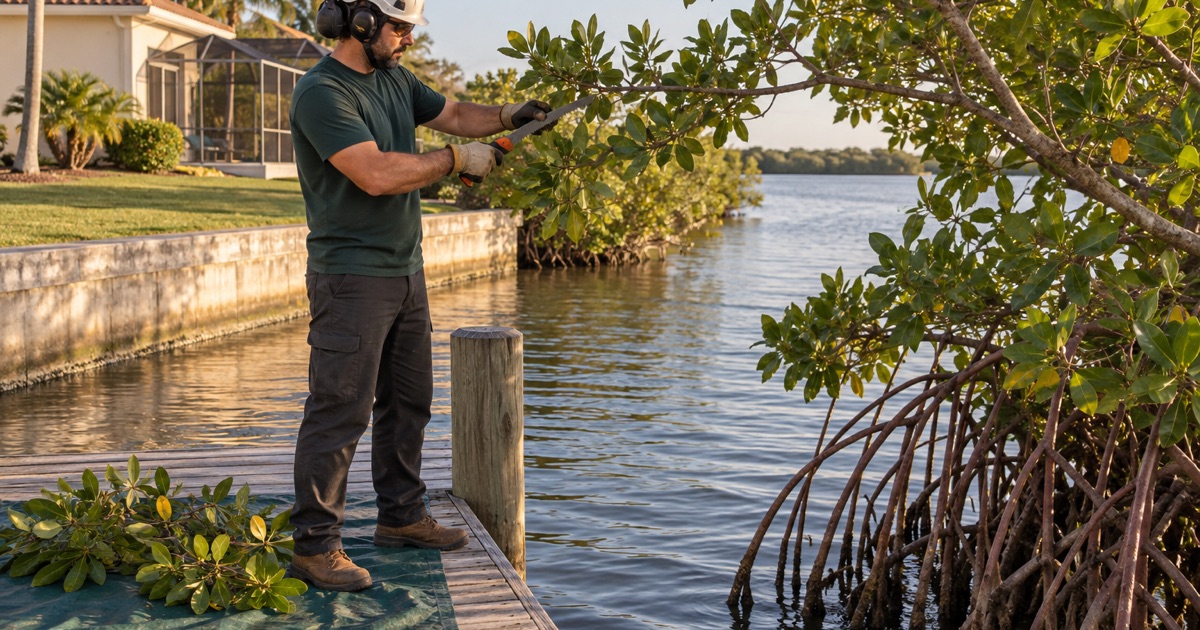
The Mangrove Trimming and Preservation Act
Mangroves are governed by the state’s Mangrove Trimming and Preservation Act, a scheme separate from and older than the local tree codes that cover everything else on a property. It defines what counts as trimming and what counts as alteration, sets out limited circumstances in which trimming may proceed without authorization, and makes anything beyond those circumstances a permitted activity. A local tree permit neither authorizes it nor substitutes for it.
Carved Out of the State Preemption
Florida Statutes section 163.045 is the provision most waterfront owners here have heard of, because it lets a homeowner remove a hazardous tree on qualifying residential property with arborist documentation and no local permit. It expressly excludes mangroves from that exemption. The documentation route that resolves an oak over a roof therefore does nothing whatsoever for the mangrove fringe at the seawall.
Buttonwood, Shorelines and What Else Is Protected
Mangroves are not the only protected shoreline vegetation, and the boundaries of a job are worth establishing before it starts. Inside the City of Bradenton, mangroves and buttonwood are protected by the city’s own code regardless of size, and coastal dune plantings elsewhere in this service area carry their own state protections. A shoreline clearing job frequently crosses more than one jurisdiction in a few feet.
Who Authorizes the Work Where You Are
Manatee County Routes to the State
Manatee County’s Environmental Planning Section states its position plainly: the county operates under the Act but, unlike some other jurisdictions, has not been granted delegated authority by the Florida Department of Environmental Protection. That is a county-wide answer and it binds the cities within it, Bradenton included. Mangrove work on frontage here is a state matter, and there is no local counter that can approve it instead.
The Neighboring Counties Hold Delegation
Cross the line and the answer changes. Sarasota, Pinellas and Hillsborough counties all hold delegated authority under the program, with the Environmental Protection Commission of Hillsborough County administering it on that side and Pinellas County’s delegation extending inside its incorporated municipalities. For an owner with property in more than one county, or a manager responsible for sites across the region, that asymmetry is the whole administrative story.
Municipal Requirements on Top
Delegation to a county is not always the end of it. At least one municipality in this service area layers its own mangrove requirement over the county’s, so a permit obtained at county level does not necessarily complete the picture. We establish the full stack for the specific address rather than assuming that what applied on the last job applies on this one.
Getting the Work Itself Right
Red, Black and White Mangrove
The three species behave differently and occupy different positions on a shoreline, with red mangrove typically at the water’s edge on its prop roots, black mangrove behind it with its pneumatophores through the sediment, and white mangrove further landward. Identifying what is actually growing on a frontage is the starting point, because the species composition and the position of the fringe shape both what may be done and what the consequences of doing it badly would be.
Qualification Is Part of the Permit Question
The state’s program recognizes the status of professional mangrove trimmer, and certain categories of trimming are tied to who performs them. That means the question of who does the cutting is not separable from the question of what is authorized. We settle both before a scope is priced, rather than quoting work and discovering afterwards that it needed a different route.
Documentation Before the First Cut
Every mangrove job we take starts with a written record: the location and extent of the fringe, the species present, the authority that applies, the scope proposed and the basis on which it proceeds. Photographs are taken before anything is touched. A cut shoreline is visible from the water for years, and reconstructing the justification afterwards is not an option available to anybody.
- 20+ Years on This Coast
- Written Estimates
- No Topping, No Hat Racking