
Bradenton Tree Removal books tree removal in Osprey the way we have booked it for twenty-plus years: the question of who signs off gets settled before a rope goes into the tree. Most of the addresses we work here need no permit at all, and the reason is a county provision rather than a state one. Knowing which of the two is carrying the job changes what we quote and how soon we can start.
The work itself is takedowns, storm-damaged removals, palm work, stump grinding and the hauling that follows. Every job goes out as a written estimate with hauling and disposal on their own line, so the cost of moving the wood is visible rather than buried in a single number. We do not top trees, hat rack them, or cut a palm back to a hurricane cut, whoever asks for it.
Palms and hardwoods get treated as the separate jobs they are, by crews who know a palm has no branch collar to cut back to. When we think a tree can stay, we say so, and when we recommend taking one down we put the reasoning in a written condition report before a saw starts.
The county rule that decides most removals here
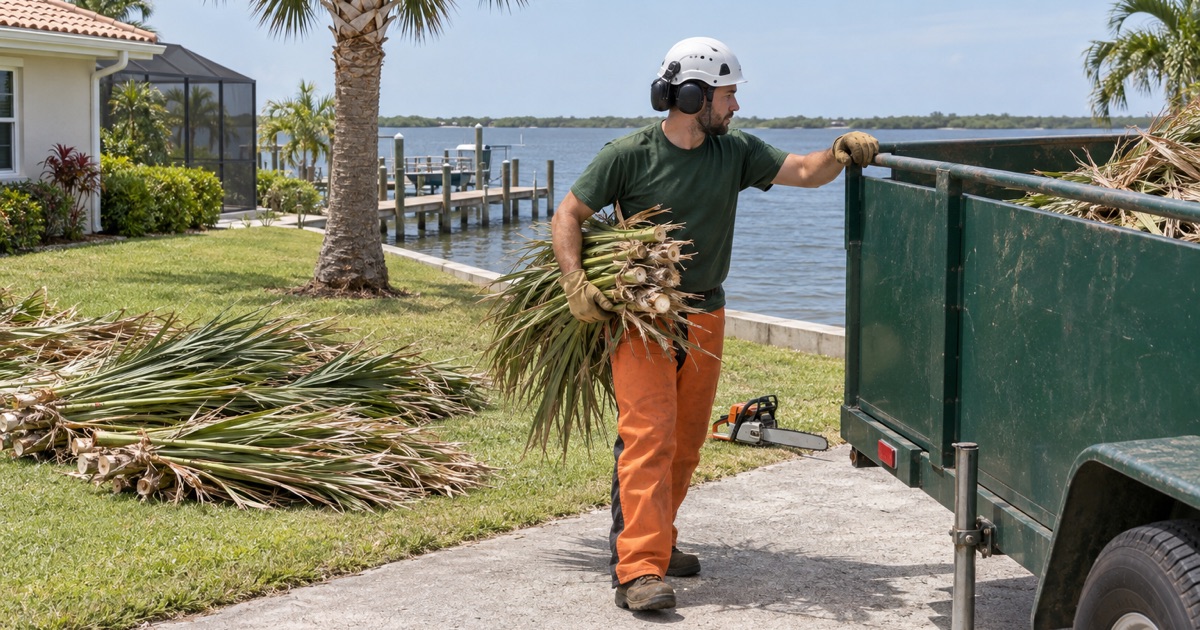
Osprey is a census-designated place in Sarasota County, and it has no municipal government of its own. There is no second tree ordinance layered over the county’s and no separate municipal solid-waste department. Chapter 54, Article XVIII of the Sarasota County Code states its own reach directly: the article is effective throughout the unincorporated area of Sarasota County, under ordinances adopted by the Sarasota County Board of County Commissioners.
The provision that governs most residential work here is section 54-585(e), headed Certain Residential Lots: “The prohibitions in Section 54-584(1) shall not apply to owner-occupied residential Lots of five acres or smaller, after a certificate of occupancy has been issued for the residential dwelling(s) on that Lot.” Read it twice for what it does not ask of you. There is no application, no fee schedule, no risk rating and no arborist letter attached to it.
That is a county exemption, adopted at county level, and it does its work on its own footing. For an ordinary owner-occupied house with a certificate of occupancy on record, the tree in the back yard simply sits outside the permit prohibition.
Why most Osprey houses land inside it
The two conditions the subsection sets, owner-occupied and a certificate of occupancy already issued, describe the ordinary house here. Of 2,893 occupied housing units, 2,504 are owner-occupied, and 1,984 of those are one-unit detached homes, per the American Community Survey 2024 five-year estimates. The exemption is not an unusual route through the code in Osprey; it is the normal one.
The housing stock is young, which shapes the work more than people expect. Of 3,722 total units, 1,154 went up between 2000 and 2009 and only 617 predate 1980. The live oaks, slash pines and sabal palmetto planted with those newer streets are now at the size where a takedown is a rigging or crane job rather than something done off a ladder.
Lots over five acres, and the teardown case
Above five acres the same subsection narrows rather than vanishes: no Tree Permit is required where the tree stands within 150 feet of the residential dwelling, once the certificate of occupancy has issued. Outside that band the ordinary permit path returns.
Two further limits sit in the same text. It does not cover trees that were planted or relocated under a Tree Permit in the first place, and it does not apply where the dwelling itself is to be demolished and reconstructed. A teardown parcel is not an exempt residential lot, and we would rather say that at the estimate than afterward.
Looking for tree-removal closer to Treasure Island? See Treasure Island Tree-Removal.
Where the five-acre exemption stops
The exemption has hard edges, and on preserve-adjacent ground they matter more than the permit path itself. It does not apply to any grand tree, on any property. It does not apply inside a canopy road protection zone, and it does not apply in a conservation or preservation area.
Grand tree status is a points test rather than a flat diameter: trunk diameter at breast height counts one point per inch, height one point per foot, and average canopy spread one point per four feet, measured against a published minimum for the species, which is 100 points for live oak, pine and bald cypress and 80 for southern magnolia and sand live oak. A grand tree must also carry a condition classification of 70 percent or better. We measure before we quote, because a tree a few points short of its species minimum and a tree a few points past it are two different jobs.
Canopy road zones are a map question
A canopy road protection zone reaches up to 15 feet laterally from the right-of-way onto adjacent private property, and inside it unauthorized pruning is a prohibited act in its own right, separate from the general permit requirement. County canopy road designations total about 24 miles in segments averaging 1,764 feet. Whether a designated segment touches a particular address has a real answer, and we check the county’s current map rather than guess either way.
What the state statute is actually for
Florida Statutes section 163.045 is the other route, and here it matters mainly for the categories the county exemption does not reach. It turns on documentation: a determination of danger from an ISA-certified arborist or a landscape architect licensed in Florida, prepared to a recognized standard such as the ISA Best Management Practices Tree Risk Assessment Second Edition 2017.
Florida issues no state tree or arborist contractor license, and section 163.211 preempts local occupational licensing, so the county cannot issue one either. What is verifiable instead is ISA certification, current general liability and workers’ compensation coverage, and crews working to ANSI Z133 with cuts made to ANSI A300.
Living beside Historic Spanish Point and Oscar Scherer
The conservation and preservation carve-out is not abstract on this stretch of the bay. Historic Spanish Point is a 30-acre National Register-listed preserve on Little Sarasota Bay, inhabited by Native Americans for roughly 5,000 years, homesteaded by John Greene Webb’s family in 1867 and purchased in 1910 by Bertha Honore Palmer of Chicago as part of her Osprey Point estate. Oscar Scherer State Park opened in 1956 and covers more than 1,300 acres known for Florida scrub-jay habitat, with the Legacy Trail running through it. Bay Preserve at Osprey, bought from the Matson family in 2006 with a Florida Communities Trust grant, now headquarters the Big Waters Land Trust.
Backing onto preserve land does not by itself put a homeowner’s tree inside a conservation or preservation area, and treating it as though it does costs people trees they were entitled to remove. Treating the opposite as true costs a good deal more. We read what is actually recorded against the parcel before telling anyone the five-acre exemption covers their tree.
Mangroves on Little Sarasota Bay
Mangroves are a separate question with a separate authority, and the answer at an Osprey address is not the answer everywhere on this coast. Section 54-582 declares all rooted species of mangrove to be trees under the article regardless of size, alongside two-inch scrub oaks and any palm with more than four and one-half feet of clear trunk.
Sarasota County is one of only seven Florida local governments the state environmental agency has delegated mangrove trimming and alteration authority to, alongside Miami-Dade, Broward, Hillsborough and Pinellas counties, the Town of Jupiter Island and the City of Sanibel. Reporting on that delegation describes its scope as the unincorporated county, with the application approved on 31 August 2016 and the ordinance effective that 1 November. Trimming here therefore runs through the county’s own program under Chapter 54, Article XXXV and the Mangrove Trimming and Preservation Act, with a professional mangrove trimmer where the work calls for one, and anything the delegation does not cover returns to the Florida Department of Environmental Protection.
Sand, hardpan and the grinder’s rated depth
The ground here is why a stump price quoted by a company that works inland reads wrong. The soil survey maps this part of Osprey as EauGallie and Myakka fine sands, a Spodosol group whose named series carries a cemented spodic horizon running from about 22 inches down to 35 inches below the surface.
That depth is the entire point. A stump grinder’s below-grade cut typically runs 12 to 25 inches, so the hardpan sits inside the machine’s working range rather than safely beneath it, and the wheel can meet a layer that behaves nothing like the sand above it. We quote grinding depth against what we expect to find rather than against a default number, and we say up front when a stump is likely to need a second pass.
Water compounds it. In most years the table rises within 6 to 18 inches of the surface for one to four months and stays within 40 inches for more than six months, which leaves chip backfill soggy and makes a wet-season drive across a lawn something to plan rather than risk. Matting and machine choice get decided before the truck is loaded.
Access, hauling and what leaves the property
Access here runs from a fenced back yard that takes a narrow-gate machine to a crane pick over a pool cage, and the machine that fits decides the crew and the day. We size that at the estimate rather than discovering it on the morning.
Wood from a removal is not curbside material. Curbside collection in the unincorporated county runs under a county franchise through Waste Pro, while land-clearing and removal debris goes to the county’s Central County Solid Waste Disposal Complex at a gate rate. Hauling and disposal stay on their own line so you can see what moving the wood actually costs.
Seasonal ownership changes how we report. Of 829 vacant units here, 413 are held for seasonal, recreational or occasional use, so a fair share of our inspections happen with nobody standing in the yard, and those go back as written findings with photographs.
Overhead lines and the responding station
Most overhead distribution here belongs to Florida Power and Light, whose published maintenance plan clears main power lines every three years and neighborhood lines every six years on average, using directional pruning back to the trunk. Their planting guidance asks 50 feet of clearance for a large tree, 30 feet for a medium one, and a large palm’s maximum frond length plus 20 feet, with 8 feet clear in front of a transformer cabinet and 3 feet behind and beside it. We plan the drop into the rigging rather than assuming anyone will pull it for us.
Emergency coverage here is a volunteer district rather than the county’s own career department. The Nokomis Volunteer Fire Department works from Station 41 on Pavonia Road, covering Nokomis, Laurel, South Osprey and Casey Key, and shares space with a Sarasota County Fire station. A county proposal in December 2024 to shift that boundary drew resident opposition and was reported unresolved, so it is worth knowing which station answers your address before a storm rather than during one.
That is also the argument for booking storm-season work ahead of the season instead of scrambling after it. A crown thinned to standard in spring, a cabled co-dominant stem, or a leaning pine taken down while the ground is dry all cost less and go better than the same tree handled in a queue behind half the county.
- 20+ Years on This Coast
- Written Estimates
- No Topping, No Hat Racking











