
Bradenton Tree Removal has handled tree removal in Palmetto for more than twenty years, and the first thing worth saying about a job here is that the city writes its own tree rules. Palmetto is an incorporated city rather than unincorporated county ground, with its own Code of Ordinances, its own Development Services Department, and its own tree removal permit. The permit question on a Palmetto lot is answered by the city, not by the county’s land development code.
That one distinction changes what a job costs and what has to happen before a saw runs. We put a written estimate in your hands before anything is cut, with hauling and disposal carried on their own line so the cost of moving the wood is visible instead of buried in a single figure. When a tree does not need to come down, we say so, and the reasoning goes on the record in writing before anyone climbs it.
What follows is what actually changes inside the city limits: the city’s own permit and how far it reaches, the state statute that overrides it on a private yard, and who shows up when something goes wrong.
A Palmetto address is not unincorporated Manatee County
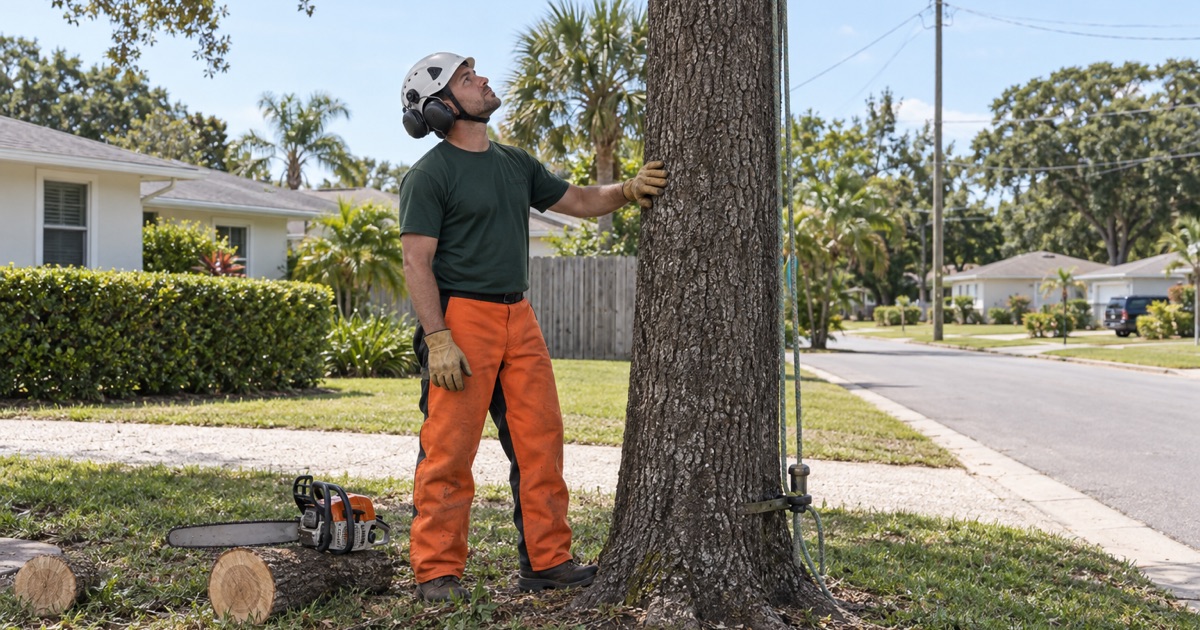
The city sits on the north bank of the tidal Manatee River, directly across the water from Bradenton, and covers 5.83 square miles. Inside those limits the city’s own code regulates the planting, removal and preservation of trees. The county’s Land Development Code tree article and its own removal permit reach unincorporated ground; on a city lot, the city’s Code of Ordinances is the authority.
That separation runs further than trees. Water and sewer service inside the city comes from the City of Palmetto Water and Sewer Department, billed through a city utility office on 8th Avenue West rather than through the county’s utility. A homeowner who assumes one government runs everything at this address will be wrong about several things at once.
Where the confusion usually starts
County resource pages sometimes list Palmetto alongside county programs, and a homeowner reading a county fee schedule reasonably concludes it governs their yard. It does not. The two permits are separate instruments issued by separate governments under separate codes, and quoting one where the other applies means the wrong application filed at the wrong counter.
We check which side of the line an address falls on before we quote any permit work. Twenty-plus years across Manatee, Sarasota, Pinellas and Hillsborough counties means we give a straight account of how the rules shift when a job crosses a jurisdiction line, rather than repeating whatever the last county told us.
What the estimate covers before the work starts
An estimate here prices the removal, the hauling and the disposal as separate lines, because on a large hardwood the wood is a bigger share of the bill than most owners expect. Access is priced for the property in front of us, from a narrow-gate machine working a fenced back yard to a crane pick over a pool cage. Neither figure is a guess made from the curb.
Stump work gets its own note. On this coast a grinder is cutting sand over a hardpan layer with a water table not far beneath it, not soil over rock, and the depth we can reliably reach below grade is a property of the ground rather than the machine’s rating alone. We tell you what a below-grade cut will actually leave behind before you pay for it.
Looking for tree-removal closer to Bayshore Gardens? See Bayshore Gardens Tree-Removal.
Section 7-224 and the city’s $50 tree removal permit
The city’s Tree Removal Permit carries a $50 fee, and the application says plainly that it is “Only for Commercial, HOA Common Area or Conservation Area.” The city’s own guidance is equally direct about the other side of that line: “You do not need authorization to remove or replace a tree in your private yard.” Most single-family removals we run in Palmetto involve no city paperwork at all.
Where the permit does apply, it is filed with the Development Services Department on 17th Street West. Association common areas, commercial sites and conservation land are the three categories named, which means a board or a property manager, not a homeowner, is usually the party holding the obligation.
The reasons the code recognizes
Section 7-224 does not treat a removal permit as a formality. A removal has to rest on one of four grounds: the tree presents a hazard to the public health, safety or welfare of the city’s inhabitants; it has contracted a disease or is infested with destructive pests; removal is necessary for construction of improvements to the property; or removal is necessary to comply with other city ordinances.
Those grounds are worth reading before a board votes on a removal, because a tree nobody likes is not one of them. We write a condition report on any tree we recommend taking down, and on association work that report is what a permit application is built from rather than an opinion offered after the fact.
One inch to one inch, measured at the caliper
When the reason for removal is construction of improvements, the applicant has to submit a plan showing that replacement can be completed “at a ratio of one (1) inch to one (1) inch measured at the caliper of such trees.” That is caliper inches out, caliper inches back — not one replacement tree for one removed tree. A single mature specimen can obligate a run of nursery stock to satisfy it.
The practical consequence is that measurements have to exist before the tree is gone. We record trunk measurements on the property, note the difference between diameter at breast height and nursery caliper so the two are not quietly swapped in a plan, and hand the numbers over with the condition report. Reconstructing a trunk diameter from a stump and a photograph after the fact is a bad position for a permit applicant to be in.
What Fla. Stat. 163.045 changes on a private yard
Since July 1, 2019, Section 163.045, Florida Statutes, has prohibited local governments from requiring “a notice, application, approval, permit, fee, or mitigation for the pruning, trimming, or removal of a tree on residential property if the property owner obtains documentation from an arborist certified by the International Society of Arboriculture or a Florida licensed landscape architect that the tree presents a danger to persons or property.” The city reprints that language in its own tree guidance.
It also tells residents to call Development Services with questions to avoid violating either the City Code of Ordinances or the state statute. That phrasing is worth noticing: the city is saying the code and the statute are two separate things a property owner can separately fall foul of, not one rule stated twice.
The documentation is the whole mechanism
The exemption is not a phone call or a conversation with a crew. It runs on signed documentation, obtained before the work, from an ISA-certified arborist or a Florida licensed landscape architect, stating that the tree presents a danger to persons or property. Where it applies, no replanting can be required either.
Florida issues no state tree or arborist contractor license, and Section 163.211 preempts local governments from creating an occupational one, so the city’s own permit cannot manufacture a credential either. The credential the statute names is the one that matters, and it is the only one we point customers toward.
Where the exemption narrows in this city
The statute is written around a single-family detached building on a lot in actual single-family residential use. Palmetto’s housing stock does not line up neatly with that description: of 7,113 housing units counted in the 2024 five-year American Community Survey estimates, 2,399 are one-unit detached and 2,205 are mobile homes, with 3,629 of 5,274 occupied units owner-occupied.
So the ownership rate overstates the statute’s reach here. A substantial share of owners in this city hold something the exemption was not drafted for, and the answer to “do I need anything?” turns on the structure and the use of the lot rather than on whether the occupant owns it.
Mangroves sit outside all of it
The city’s southern edge is tidal river frontage, and mangroves there answer to neither the city permit nor the state exemption. Manatee County states that it “has not been granted delegated authority by the FDEP” for mangrove work, and nothing found gives Palmetto a delegation of its own, so trimming and alteration remain with the Florida Department of Environmental Protection under the Mangrove Trimming and Preservation Act.
Section 163.045 also expressly excludes mangroves from the risk-documentation exemption, which means the arborist letter that settles an oak settles nothing on the shoreline. On a waterfront property we separate the mangrove question from the tree question before quoting either.
Who responds here, and where the wood goes
An independent fire district, not a city department
Fire protection inside the city limits comes from the North River Fire District, an independent special fire control district rather than a municipal department. Its own description puts it at 82 square miles covering the communities of Ellenton, Gillette, Memphis, Palmetto, Parrish, Palm View and Piney Point, with administration and a station at 1225 14th Avenue West in Palmetto.
That is a real difference from Bradenton, an incorporated city of comparable standing that runs its own fire department. For a homeowner it matters at exactly one moment: when a limb is down across a lane or hung on a service drop overnight and you are deciding who to call. Anything touching an energized conductor is Florida Power and Light’s line, not ours and not the district’s, and we will say so rather than take the work.
Yard waste at a city curb
The city’s collection rules are specific and enforced by simple refusal: “Yard waste not properly prepared will not be collected.” Material has to go out in reusable containers, tied bundles no longer than four feet, or compostable kraft paper bags, and household garbage has to be kept separate from it.
Limbs are to be cut to four-foot lengths, tied, and placed in bundles of 50 pounds or less, with branches larger than six inches in diameter excluded and a limit of ten cans or bundles. A whole-tree removal produces far more than ten bundles and a great deal of wood over six inches, so the curb is a cleanup route for pruning, not a disposal plan for a removal.
Hauling, and what the gate charges
What we haul goes to the county’s Lena Road Landfill, where the schedule effective October 1, 2025 charges $44.00 per ton for yard waste against a $23.00 minimum. Mixed and uncovered loads are double charged, and material originating outside Manatee County is triple charged. Those rates apply to a load from a Palmetto address exactly as they do to one from anywhere else in the county.
That is the number sitting behind the disposal line on our estimate, and we would rather show it than average it into the price of the cut. We work to ANSI A300 pruning standards and ANSI Z133 safety practice, we book storm-season work before the season rather than scrambling after it, and we do not top, hat rack or hurricane cut any tree or palm, whoever asks. Owners who are not here year-round get written findings and photographs, so an inspection still means something when nobody is standing in the yard.
- 20+ Years on This Coast
- Written Estimates
- No Topping, No Hat Racking











