
Bradenton Tree Removal books tree removal in Sarasota under a set of rules the city wrote for itself, and that single fact changes more about a job here than the tree ever does. The ordinance governing your yard is not the county’s. It sits in Article VII, Division 3.1 of the City of Sarasota Zoning Code, and it is administered by the Director of Neighborhood and Development Services and a City Arborist.
We have spent more than twenty years taking trees down on this coast, and at a city address the useful half of that experience is procedural as much as physical. Before anything is cut you get a written estimate with hauling and disposal broken out on their own line, so what it costs to move the wood is visible rather than folded into one number. On any tree we recommend taking down, a written condition report comes first, and the reasoning is on the record before a saw starts.
We do not top trees, we do not hat rack them, and we do not put hurricane cuts in palms, whoever asks for them. When pruning or a cable is the honest recommendation, that is the recommendation you get in writing. And where a tree genuinely has to go, the first question at a Sarasota address is which of two documents actually governs the removal, because they no longer say the same thing.
Two sentences that were meant to match
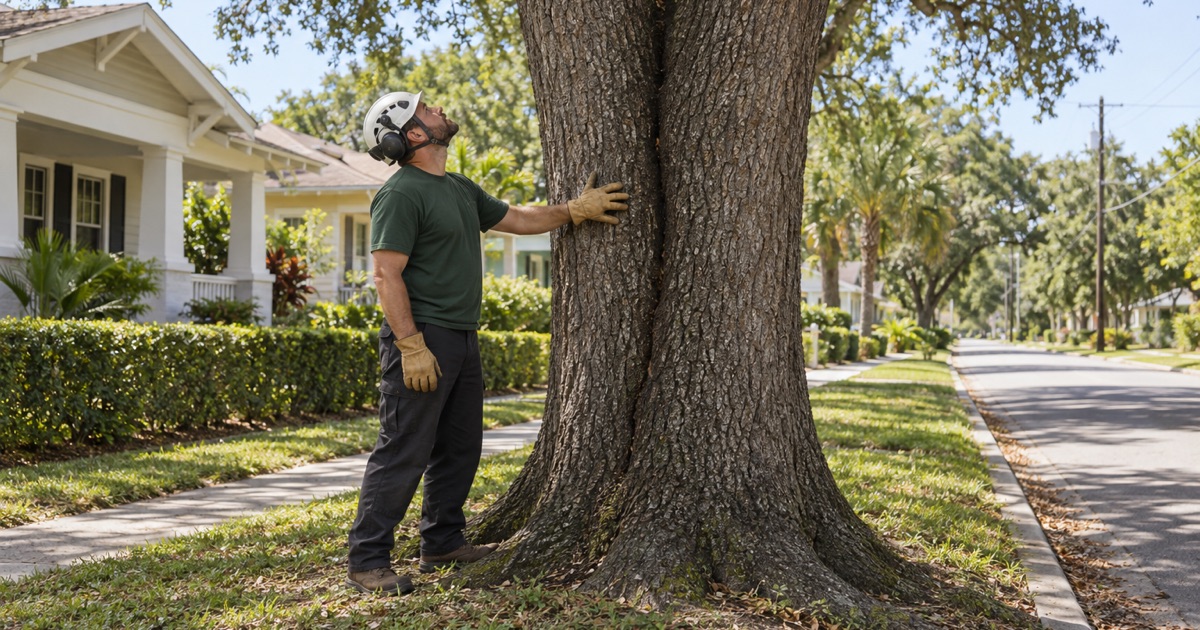
The city writes the state’s residential exemption into its own tree ordinance twice, at Section VII-310(e) and again word for word at Section VII-320(1)(n). Both passages say the city does not require a notice, application, permit, fee or mitigation for the pruning, trimming or removal of a tree on residential property if the property owner obtains documentation from an arborist certified by the International Society of Arboriculture or a Florida licensed landscape architect that the tree presents a danger to persons or property. That is no longer what the statute says.
The wording the legislature replaced
Florida Statutes section 163.045 was amended by chapter 2022-121, and the amendment changed both halves of the test. The owner must now possess the documentation rather than obtain it, and the finding must be that the tree poses an unacceptable risk to persons or property rather than that it presents a danger.
Unacceptable risk is a defined term rather than a judgment call. The statute ties it to the ISA Best Management Practices Tree Risk Assessment, Second Edition, published in 2017, and it is satisfied only where removal is the only practical means of mitigating the tree’s risk below moderate. A tree most people would call dangerous can still sit above that line once it is assessed properly, and where the two texts differ it is the statute that binds a local government.
Guidance that never mentions the pathway exists
The city’s own public Tree Protection page is thorough about what it covers. It states when a permit is required, reproduces the grand tree definition exactly as the code does, walks through the application steps, explains the orange ribbon marking, and gives inspection contacts. Nowhere on it does the exemption appear: not the statute number, not the phrase, not any residential pathway at all.
So an owner reading only the guidance comes away believing a permit is the only route, while an owner reading only the ordinance is handed a standard the legislature retired. We treat that gap as part of the work. A condition report we write for a Sarasota property is written to the standard the current statute actually sets, in the language the current statute actually uses, not to the sentence the ordinance still carries.
Looking for tree-removal closer to Lakewood Ranch? See Tree-Removal Services in Lakewood Ranch.
What counts as a grand tree inside city limits
Grand tree status here turns on species, diameter and condition together, and it catches owners out in both directions. Section VII-310 sets the thresholds: a live oak or sand live oak at twenty-four inches diameter at breast height or greater, or a slash pine, longleaf pine or southern red cedar at twenty inches or greater. The tree must also be rated good or moderate by the City Arborist.
Condition is half the test
The code defines its own ratings. Good means good health and structural stability with potential for longevity; moderate means fair health, or structural defects that treatment may mitigate; poor means poor health or significant defects in structure that cannot be mitigated, on a tree that can be expected to decline regardless of management. A large live oak in poor condition is therefore not a grand tree at all, whatever the tape reads around its trunk.
That is why we measure diameter at breast height and assess structure on the same visit, rather than treating the tape as the answer. Included bark at a union of co-dominant stems, a compromised root plate, decay found at the root collar: those are the observations that move a tree between the ratings, and they belong in the report before anyone applies for anything.
Four findings, and a recent worked example
Removal of a grand tree is prohibited outright unless the Director of Neighborhood and Development Services makes one of four findings: advanced decline confirmed by a certified arborist or state-registered landscape architect, with a resistograph or similar test unless the tree is obviously dead or diseased; a structure or infrastructure improvement sited where the tree stands, after all reasonable relocation efforts; that preserving the tree would render at least a quarter of the buildable or parking area unusable; or an imminent safety hazard that removal would mitigate.
The city produced a dated example of that process recently. In the Marie Selby Botanical Gardens Master Plan Phase 2 review, approved by the City Planning Board on a 4-0 vote on 7 August 2025, Development Services staff reported the plan removing 102 of 241 documented trees, seventy-nine of them in garden display areas exempt from parts of the tree code under the institutional botanical garden exemption. Seven grand trees were included, five of them found in poor condition after Hurricanes Helene and Milton, and the removals cleared the Development Review Committee and the City Arborist with nearly two hundred replacement trees planted as mitigation.
Mangroves, and the one permit the city cannot issue
The ordinance classifies all four mangroves, red, white, black and buttonwood, as trees, so they fall inside the same protected tree definition as an oak. Section VII-319(5) then provides that a city tree removal permit will not be issued for the removal or alteration of any of them unless the state Department of Environmental Protection has already issued a permit, a copy of which must accompany the city application. The order is the point: the state permit comes first and the city permit follows it.
Sarasota County government holds a delegation from the state under the Mangrove Trimming and Preservation Act for the territory it governs, which is why mangrove questions in this region are so often answered as though a local office issues the permit. The City of Sarasota holds no such delegation. Inside city limits a mangrove permit is a direct Florida Department of Environmental Protection South District permit, applied for at the state.
The residential exemption does not rescue a mangrove job in either version of the wording, because statute and ordinance both carve mangroves out. An arborist letter that would clear an oak clears nothing here, and trimming within the state’s rules is work for a professional mangrove trimmer under state authorization. One caution, because it travels: the ordinance’s own citation of the mangrove statutes is miscopied in the code text, so a range lifted from the ordinance rather than from Florida Statutes sections 403.9321 through 403.9333 carries that error forward.
How that splits a shoreline estimate
On a waterfront property we separate what is unambiguously upland from what is not before quoting anything. Upland removals move on the city’s timeline; anything in the mangrove fringe waits on the state, and that goes in the estimate rather than surfacing on the morning of the work. It is also why hauling and disposal sit on their own line: a job split across two authorities is often two mobilizations, and the price should show that.
The parts of the code nobody applies for
Two obligations run at a Sarasota address whether or not a permit is ever pulled. Between them they account for a fair share of the work we do here, and neither has an application form.
Clearance over the sidewalk and the street
Section VII-313 puts a standing duty on the owner or occupant: trees may not extend over a public sidewalk or right of way unless kept trimmed to ten feet over the sidewalk and fourteen and a half feet over any street or public right of way. No permit is involved and no notice from the city is needed to trigger it. It is simply a condition the property is expected to be in, and the lift clearance that satisfies it is cut to ANSI A300 pruning standards rather than headed back to a stub.
Overhead lines are a separate matter with a separate owner. Florida Power and Light states that trimming trees within ten feet of a power line is the customer’s responsibility, and that its own crews use directional pruning, removing whole branches and limbs back to the main trunk. Work closer to an energized conductor than ANSI Z133 permits for a crew of our qualification does not get done by us, and we will tell you which call to make instead.
Who the exemption actually reaches
The statute is narrower than it sounds. It reaches a single-family detached building on a lot actively used for single-family residential purposes, and only about 26.8 percent of this city’s housing units are owner-occupied detached homes. Condominiums, apartments, townhomes, duplexes and every commercial or institutional parcel remain inside the ordinary Division 3.1 permit process no matter what an arborist writes.
The older half of the housing stock is where the large trees are, with 58.4 percent of homes built before 1980, and those are the lots carrying mature live oaks over a roof line and a driveway never sized for a chip truck. Access gets matched to the property rather than the other way round: a narrow-gate machine through a fenced side yard on one lot, a crane pick over a pool cage on the next.
Contractor requirements, and one credential that does not exist
Section VII-317 requires contractors, subcontractors and tree service contractors pruning, planting, trimming or removing trees within the city to hold a valid local business tax receipt and valid proof of workers’ compensation, public liability and property damage insurance. Those are checkable, and worth checking on any bid you take. What Florida does not issue is a tree or arborist contractor license, and Florida Statutes section 163.211 preempts local occupational licensing of the trade, so a firm implying otherwise is describing a credential that does not exist.
One narrower route is worth knowing if the tree is not a grand tree. Section VII-320(1)(l) offers a simplified permit for removals done to re-landscape an existing qualifying residence, meaning a single-family residential structure owner-occupied for at least a year, without a site plan drawn by a landscape architect or engineer. Standard mitigation still applies, except where the City Arborist finds the removal corrects an over-density of trees under right tree, right location criteria, in which case no replacement trees or mitigation fees are required.
Whichever route a job takes, the sequence is the same: assess the tree, write the condition report to the standard the statute sets today, then say plainly which permit the removal needs, city, state or none. Storm-season work goes better booked before the season than scrambled after it, and for owners who are not in town year round the findings and photographs go out in writing, so an inspection still means something with nobody standing in the yard.
- 20+ Years on This Coast
- Written Estimates
- No Topping, No Hat Racking











