
Bradenton Tree Removal prices tree removal in Siesta Key by settling one question before any other: how close to the water the trunk actually stands. Twenty-plus years on this coast have taught us that two lots a few hundred feet apart can answer to two different regimes, one facing the Gulf and one facing the bay. All of it goes into a written estimate before anything is cut, with hauling and disposal broken out on their own line so the cost of moving wood off a barrier island is visible rather than folded into one number.
Any tree we recommend taking down gets a written condition report first, framed the way the ISA Best Management Practices for Tree Risk Assessment frame risk, so the reasoning is on the record before a saw starts. When the honest recommendation is a prune or a cable instead of a removal, that is what we quote. We do not top, hat rack or hurricane cut, on any tree or any palm, whoever asks for it.
Palms and hardwoods are separate jobs and we crew them that way, because a palm has no branch collar to cut to. Access is sized to the property, from a narrow-gate machine in a walled courtyard to a crane pick over a pool cage. Owners who spend part of the year elsewhere get photographs and written findings, so an inspection still means something with nobody standing in the yard.
Two shorelines, one key, one county
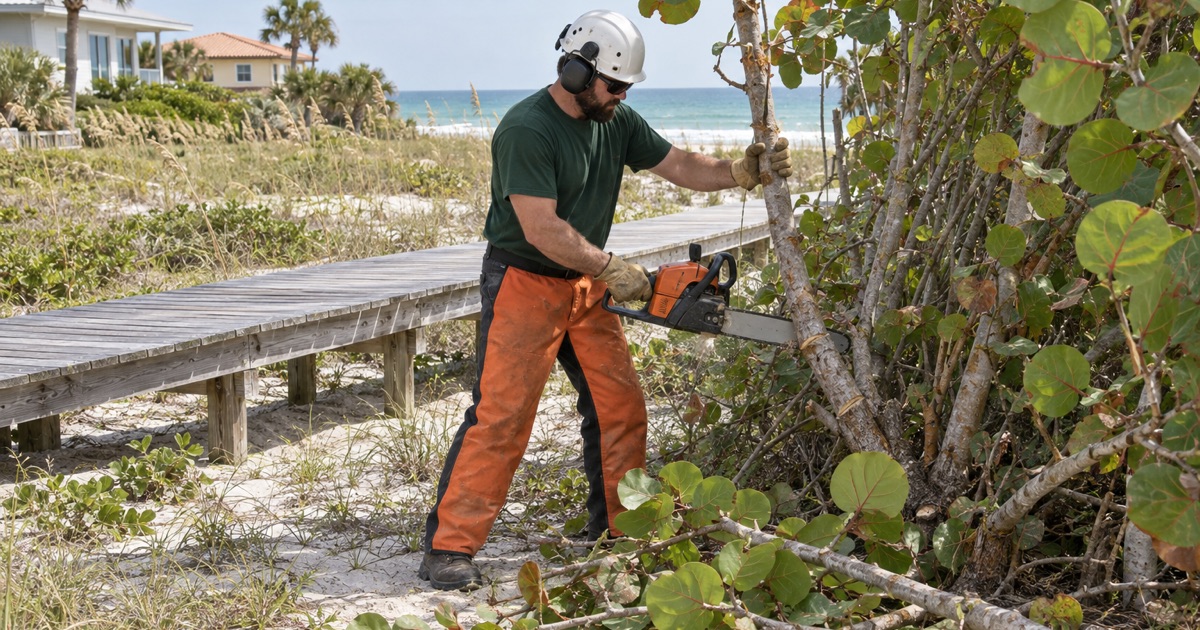
Siesta Key is a barrier island lying between Roberts Bay and the Gulf of Mexico, and the majority of it is unincorporated Sarasota County rather than any municipality of its own. A mailing address here carries a Sarasota city name for postal purposes only: the City of Sarasota’s own zoning code does not reach most of the key, and the Sarasota County Board of County Commissioners is the body whose ordinances answer a zoning, land-clearing or tree question at those addresses. When a caller tells us a landscaper is applying to the city for a permit, that is the first thing we check.
Landward of the coastal lines, the ordinance that reaches a lot here is the Sarasota County Code of Ordinances, Chapter 54, Article XVIII, with its permitting criteria and its point-based grand tree schedule at section 54-586 and its exemptions at section 54-585. On an inland parcel that code would be most of the story. On this key it is the floor rather than the ceiling, because a further layer sits above it depending on which shoreline the property faces.
Three lines, not one, on a Gulf-front parcel
The state’s Coastal Construction Control Line is the one people have heard of, and it is not the only line drawn across a beachfront lot here. As the county’s land development regulations in Chapter 74 are summarized, Sarasota County applies its own Gulf Beach setback line and a Barrier Island Pass Twenty Year Hazard Line in addition to the state line, and a development plan touching land seaward of them has to depict all three. A lot that used land seaward of those lines to satisfy its minimum area still has to hold adequate buildable area landward of them.
We read that from an indexed summary of the county code rather than a re-fetched primary text, so we treat it as a reason to confirm rather than a settled quote. What it means in practice does not change: we get the mapped lines for the specific parcel before a crew is scheduled, not after a machine is already on the sand.
Looking for tree-removal closer to Tierra Verde? See Tree-Removal Services in Tierra Verde.
The Gulf side: maintenance, damage, and the difference between them
Seaward of the state control line the county tree code is not the operative rule. Florida Statutes section 161.053 makes it unlawful to damage sand dunes or the vegetation growing on them without a permit from the Florida Department of Environmental Protection, and section 161.242 adds protection naming two species outright: sea oats, Uniola paniculata, and sea grape, Coccoloba uvifera. The department runs that program out of its Office of Resilience and Coastal Protection under Florida Administrative Code Rule Chapter 62B-33. Those rules do not supersede stricter requirements of other laws or jurisdictions, so satisfying the state layer does not satisfy the county one.
The department’s March 2022 dune plant maintenance guidelines draw the line we work to. Trimming, shearing, pruning, dead heading and other accepted horticultural practices do not damage native dune plants and do not require a control line permit. Damage means a material reduction in a plant’s health through trampling, crushing, chopping, breaking, digging up or excessive cutting of roots, stems, trunks, branches or leaves, and excessive cutting is measured against the ANSI A300 pruning standard, which is what we prune to regardless. Maintenance aimed at ornamental or introduced non-native species, or work that damages no native beach-dune vegetation and involves no excavation, is exempt from the permit application requirement.
Which of the three zones the tree is standing in
The department’s own diagram divides a Florida beach-dune system into three bands moving inland. Nearest the water is a pioneer zone of sea grape, sea oats, bitter panicum, beach cordgrass, beach elder and beach morning-glory, the first plants on the beach and the ones that build the dune by trapping wind-blown sand. Behind it sits a scrub zone kept low and shrubby by wind and salt spray, saw palmetto, inkberry and yaupon among it. Furthest inland is a forest zone of mature live oak, red bay and cabbage palm, protected from salt spray by the two zones seaward of them.
That last clause is a service condition, not a caption. A Gulf-front lot that loses its pioneer and scrub cover, whether to a storm or to unauthorized clearing, exposes forest-zone trees to a salt load they never grew into, and the consequence shows up a season or two later rather than that week. So when we walk a beachfront property we say which zone each tree stands in, because the zone predicts the species, the permit and the follow-up work all three.
Sea grape, and what the guidance actually says
Sea grape carries a note in the department’s guidance that a crew ought to know before treating it as an ordinary regulated tree: certain coastal plants adapted to recover from breakage in tropical storm force winds, sea grape among them, are tolerant of heavy pruning or coppicing. That is a horticultural observation, not a permission slip. Sea grape is named in statute for additional protection, and removal or cutting beyond accepted practice still requires a permit seaward of the control line. What it does mean is that a hard reduction we would refuse on a less storm-adapted species can be the right call on this one, done to standard with the paperwork in hand.
Nesting season sets the calendar, and the lighting sets the design
Sea turtle law sits directly on top of the vegetation rule for Gulf-front canopy work here. Hatchlings orient to light, so removing beachfront vegetation raises the risk of disorientation and death, and vegetation maintenance that increases lighting of the beach has to comply with the Marine Turtle Protection Act at Florida Statutes section 379.2431. On a beach lot that turns a pruning decision into a lighting decision, because taking a screen out between a house and the water changes what is visible from the sand even when every cut was permitted.
The staging rule is the one that moves dates. The department’s guidance directs that operation, transportation or storage of equipment on the beach or frontal dune, skid steers and cherry pickers included, be scheduled outside sea turtle nesting season or coordinated with control line and Florida Fish and Wildlife Conservation Commission staff if it is proposed during the season, which can mean engaging a state permitted biologist. That is the argument for booking storm-season work ahead of the season rather than scrambling after it.
This key is not a hypothetical for storm work. In its advisory issued the evening of 9 October 2024, the National Hurricane Center recorded the eye of Hurricane Milton making landfall near Siesta Key in Sarasota County as an extremely dangerous category 3 hurricane with maximum sustained winds of 120 mph. We put no figure on what that did to the trees here, because no report we work from carries one; what we do instead is look at leaners, root plates and palms showing spear leaf collapse in the spring rather than in the week a warning goes up.
The bay side, and the narrow door the state exemption leaves
The eastern shoreline faces Little Sarasota Bay and the Intracoastal Waterway, and it runs under an authority of its own. Mangrove trimming and alteration falls under the Mangrove Trimming and Preservation Act at Florida Statutes sections 403.9321 through 403.9333, and Sarasota County has held delegated authority from the Department of Environmental Protection for that program since 2017, covering the unincorporated county. A bay-side mangrove trim on this key is therefore a county matter rather than a direct state one, handled by a professional mangrove trimmer with the trimming plan written before anyone is standing in the water.
Florida Statutes section 163.045 is the law owners raise most, and it repays being precise about. It lets an owner skip local notice, permit and fee for tree work on a single-family detached home actively used as one, where the owner holds documentation from an ISA-certified arborist or a Florida licensed landscape architect that the tree poses an unacceptable risk to persons or property under the ISA Tree Risk Assessment best management practices, second edition. By its own text the statute does not apply to specifically delegated mangrove authority, so on the bay side of this key that arborist letter buys nothing. It does not reach a condominium or any other attached building either, and it does not displace the coastal control line regime on the Gulf side.
Owner-occupied detached houses are 17.3 percent of the housing stock on this key, which turns the statewide framing on its head. The route a general article describes as the normal one is the exception here, and we check a parcel against the control line and the delegated mangrove program before telling anyone they may proceed on documentation alone.
Sand, a high water table, and the stump
Grinding on this key meets a different profile than the flatwoods soils a few miles inland. The state’s soil layer returns Pompano fine sand, depressional, at a coordinate here, a very poorly drained hydric sand with no spodic horizon and no clay layer at all, unlike the EauGallie and Myakka soils we grind through elsewhere in this county. What the machine meets instead is water. The series description puts the seasonal high water table within a foot of the surface for two to six months of most years, and the depressional phase ponds for roughly three months.
So we set the below-grade cut for what is going back into the hole rather than to a default depth, and we say plainly when ground is too saturated to work until it drains.
Two things we say on every estimate here
Florida Power and Light puts trees within 10 feet of a power line on the customer to have trimmed by a qualified tree trimmer, and its own line clearing is directional pruning that takes entire branches and limbs back to the main trunk. That is worth knowing before assuming the utility’s crew will treat your tree the way you would.
Florida also issues no state tree or arborist contractor license, and Florida Statutes section 163.211 preempts local occupational licensing of the trade, so a credential claim from anyone quoting tree work on this key deserves a close read. What we put on the record instead is the written condition report, the pruning standard we work to, and a straight account of which authority signs off on your particular lot.
- 20+ Years on This Coast
- Written Estimates
- No Topping, No Hat Racking











