
Bradenton Tree Removal handles tree removal in South Pasadena mostly for condominium boards and property managers rather than for an owner standing in a front yard. That changes the paperwork far more than it changes the saw work. Before anything is cut we put a written estimate in front of you, with hauling and disposal priced as their own line so the cost of moving the wood is visible rather than buried in a single number.
When we recommend taking a tree down, the reasoning goes on the record first, in a written condition report a board can read into its minutes and an owner can keep. When a tree does not need to come down, we say so, and we will tell you where a reduction cut or a cable is the honest answer instead. Twenty-plus years of tree work on this coast stands behind either recommendation.
We cut to ANSI A300 and rig to ANSI Z133, and we treat palms and hardwoods as the genuinely different jobs they are. No topping, no hat racking and no hurricane cuts, on any tree or any palm, however the request arrives. Access is usually the real constraint here, so we size the machine to the property: a narrow-gate unit down a service walk, or a crane pick when the drop zone is a pool deck and a row of parked cars.
The tree here usually belongs to everybody
This is a city of buildings rather than yards, and the housing numbers say so plainly. American Community Survey 2024 five-year estimates count 4,998 housing units, of which 3,774 — 75.5 percent — sit in buildings of twenty units or more. Owner-occupied one-unit detached houses number 237, which is 4.7 percent of the stock. Almost every mature tree in the city therefore stands on a common element rather than on a lot one person controls.
That single fact reorders the whole job. The decision-maker is a board acting under a declaration and its own grounds procedure, not a homeowner holding an arborist’s letter. Our estimate has to survive being circulated, questioned at a meeting and voted on, which is why we write it to be read by people who were never standing under the tree with us.
What the state exemption actually reaches
Florida Statutes section 163.045 is the provision that lets a residential property owner take down a dangerous tree without a local permit when a certified arborist or a licensed landscape architect documents the risk. The statute defines residential property narrowly: a single-family, detached building on a lot actively used for single-family residential purposes. In this city that definition reaches roughly one address in twenty.
For the other nineteen the statute is not in play at all. No risk letter converts a common-element tree into an exempt one, and a tree in a parking island or a courtyard remains subject to whatever the declaration and the city’s code require. We would rather say that at the estimate stage than have a board discover it after a vote.
What a board actually needs from us
Boards run on records, so we work to leave one. A risk assessment carried out on the ISA Best Management Practices Tree Risk Assessment Second Edition 2017 framework gives a board something defensible to attach to a motion, whether the answer is removal, a reduction or another look in a year. Where a master document assigns a tree to the association rather than to a unit, that document decides who is buying the work, and we ask to see it before pricing anything that touches an irrigation line, a walkway or a parking bay.
The stock here is mixed in ways that change who signs. Nearly four hundred mobile-home units and a large rental share mean the person who calls is often not the person who can authorize the work. Owners who are here for only part of the year get written findings and photographs, so an inspection still means something when nobody is on site to walk the property with us.
Looking for tree-removal closer to Apollo Beach? See Tree-Removal in Apollo Beach.
Chapter 183, and a permit that costs $25 a tree
The city keeps its own tree chapter: Chapter 183, Trees, running from section 183-1 through section 183-9 and cross-referenced from Chapter 130, the land development regulations. The consolidated fee schedule in Chapter A198 lists the charge for a tree removal or relocation permit application at $25 per tree. That is a city permit at a city address, and it applies whether the tree stands beside a unit door or in a landscape island off Pasadena Avenue South.
We read the current chapter language with the city before we file, rather than working from a copy in a folder. The substantive parts — what counts as protected, what is exempt, what replacement is asked for — are exactly the parts that get amended, and a stale copy is how a job gets quoted wrong. Preparing the application, the sketch and the tree count is our work, not the board’s.
A name that misdirects a search
One practical warning, because it costs people real time. A far larger city elsewhere in the country carries this same name, and an unqualified search for the tree ordinance returns that city’s rules, its council coverage and its recent ordinance rewrite ahead of anything local. Its chapter numbers, its thresholds and its fees have nothing whatever to do with an address here.
Everything we work from is checked against the city’s own site or its code host before it reaches a quote. If a manager sends us a screenshot of a tree ordinance that does not match Chapter 183, that is usually what happened, and it is worth catching before a permit application goes in under the wrong assumptions.
Built-over ground: what the soil map says, and does not
Florida’s soil survey mapping for a coordinate in this city returns map unit 30, named urban land, logged as a consociation at 100 percent with no soil order recorded at all. That is not a description of a soil. It is the survey saying the ground has been built over past the point of describing. On a city of 0.61 square miles carrying that many multi-unit buildings, the reading is unsurprising and it is honest.
In practice a crew here is grinding stumps in engineered fill, compacted subgrade and imported landscape soil around pool decks, podium planters and parking structures, not in a natural profile. Grinding is slower and harder on teeth in that material, and buried irrigation, conduit and slab edges sit far closer to a root plate than they would in a yard. We probe before the grinder goes in, and we say up front how deep a below-grade cut we can commit to in a given spot.
Root plates that were never given room
A tree set in a curbed island or a raised planter builds a root plate shaped by the concrete around it, and that shape is often the whole reason the tree is leaning. Root collar excavation with an air spade tells us whether we are looking at a girdling root, a burial depth problem or genuine structural failure. On a tree worth keeping, that answer can turn a removal into a correction, and soil decompaction in what room remains does more good than any pruning we could sell.
Co-dominant stems with included bark are the other common find on landscape trees of this era, planted close to walkways and never given a structural pruning cycle. Cabling and bracing is sometimes the right call and sometimes a way of postponing a removal at a worse time of year. We will tell you which one we think it is.
Getting the wood out
Removal cost here is largely a hauling problem. A drop zone that is a courtyard, a covered walkway or a resident parking bay means smaller pieces, more trips and a longer day, and that is why disposal sits on its own line in our estimate instead of hiding inside a lump sum. Yard waste crosses the county disposal scale at the same gate rate as household garbage, $58.86 a ton at last publication and rising 8 percent on October 1, with a $100-per-load contractor surcharge on loads needing extra processing.
Bay frontage, and the rules that do not come with it
The water here is Boca Ciega Bay, on the inner coast, not the open Gulf. There is no Gulf beach at a city address, so the beachfront restrictions that shape work on the barrier-island properties across the water do not reach a job here at all. That removes a layer of permitting, and it also removes an excuse: nothing about a bay-facing complex justifies a shortcut on rigging or cleanup.
What the bay frontage does bring is mangroves. Trimming or altering them is not a city matter, and Florida Statutes section 163.045 does not touch them either — subsection (4) leaves the Mangrove Trimming and Preservation Act expressly alone. Under a 1996 delegation from the state, the Pinellas County Department of Environmental Management issues mangrove trimming permits within the entire territorial limits of the county, and the city holds no separate delegation of its own. Where a fringe sits in an access route or a crane setup, we plan around it or bring a professional mangrove trimmer in under that county permit.
The trees a bay lot actually grows
Sabal palmetto, live oak and sea grape hold up to salt on a bay lot better than most, while a laurel oak planted tight to a building rarely earns the room it takes. Palms fail here for their own reasons: Ganoderma butt rot at the base, lethal bronzing moving through a stand, spear leaf collapse after a wet season. None of those are pruning problems, and none are solved by stripping a crown.
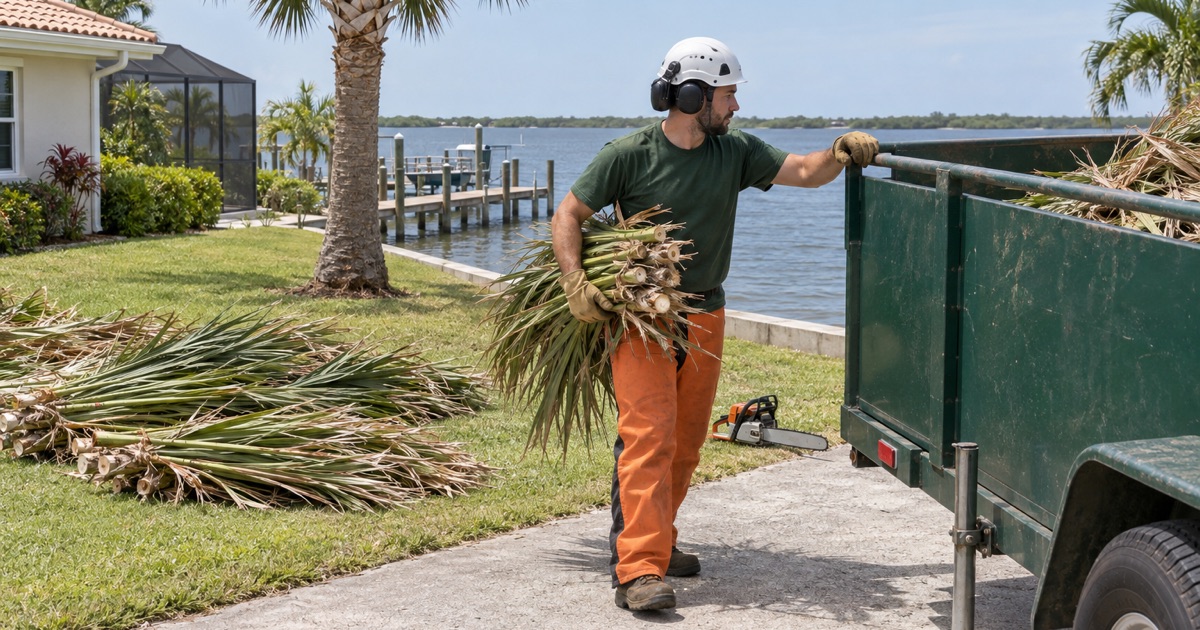
We cut palms to the nine and three clock rule and leave a self-cleaning species to shed on its own. A frond skirt taken down on a schedule is maintenance; a crown cut back to a pencil point is damage a board will be paying for in replacements years later. That is the same reasoning behind refusing to hat rack a hardwood, whoever is asking.
Booking before the season, not after it
We work across Manatee, Sarasota, Pinellas and Hillsborough counties, and the rules genuinely change at those lines. At an address in this city the answers are Chapter 183 at city hall and, for anything in a mangrove fringe, the county under its state delegation. We will give you a straight account of both before you commit to anything.
Storm work goes better booked before a season than scrambled after one, and on a property where every removal needs a board decision the lead time is the entire point. Written condition reports in spring, votes taken while there is room in the calendar, and the questionable trees down before anyone is watching a forecast — that sequence is the difference between a planned expense and an emergency one.
- 20+ Years on This Coast
- Written Estimates
- No Topping, No Hat Racking











