
Bradenton Tree Removal books tree removal in St. Petersburg the way the city’s own paperwork insists it be done, which is permit number first, saw second. Twenty-plus years on this coast has taught us that the documentation and the cutting are one job, not two. We quote the removal, the hauling and the disposal as separate lines, so you can see what moving the wood actually costs before anyone leaves the ground.
Before a saw starts we put a written condition report on any tree we recommend taking down, so the reasoning is on the record instead of in somebody’s memory. When a tree does not need to come out we say so, including the times a reduction cut or a cable is the honest recommendation. We do not top, we do not hat rack, and we do not cut a hurricane skirt into a palm, whoever asks for one.
Palms and hardwoods come off a property as the different jobs they are, handled by crews who know a palm has no branch collar to cut back to. Access sets the method more often than the tree does, from a narrow-gate machine behind a fence line to a crane pick over a pool cage. We work Manatee, Sarasota, Pinellas and Hillsborough counties, and give a straight account of how the rules change at each line.
The brush site will not take the wood without a permit number
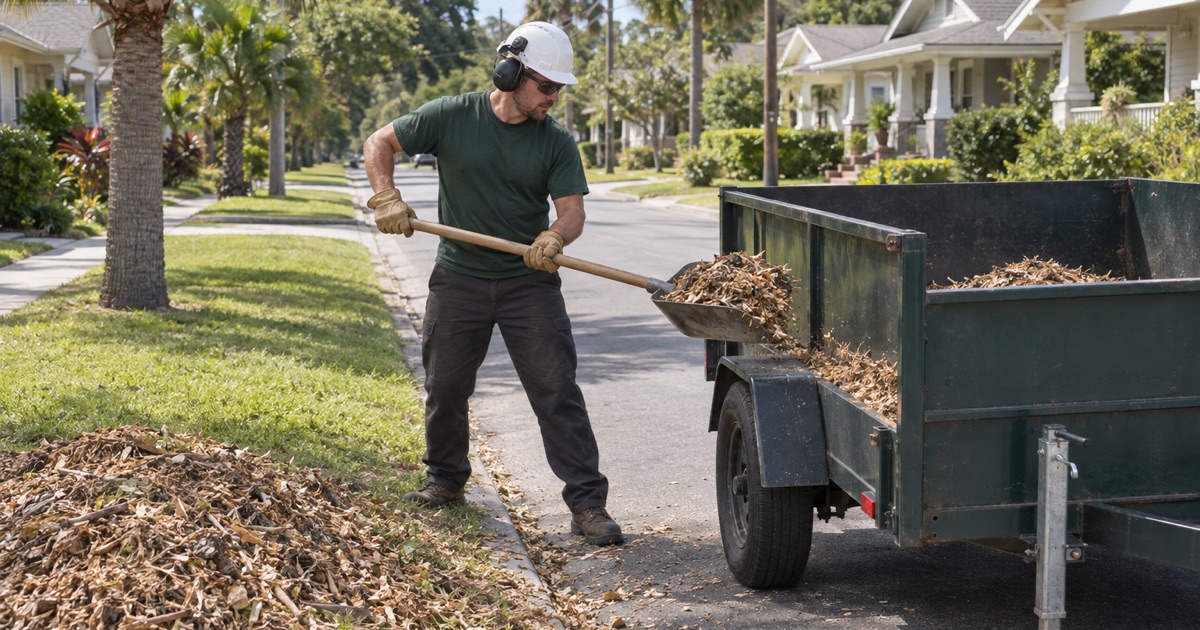
The sharpest fact about tree work in this city is not in the tree ordinance at all. It is on a one-page form at the disposal gate: the Brush Site Consent Form requires, as a condition of entry, either a City Tree Removal Permit or City documentation number, or the name of an unprotected tree species. A truckload of oak with neither entry filled in gets turned around.
One form, one address, one day
Both the property owner and the company performing the work sign it, and the city states that a form must be provided each day at time of delivery and that loads from multiple addresses will not be accepted. Origin is checked against a driver’s license and, for a hauler who is not a city resident, against the water account number of the property the material came from. Failure to comply, in the city’s own words, results in loss of permission to the contractor to use the brush sites.
That is why we settle the permit question at the estimate, not on the morning of the work. A crew that arrives to a protected tree and no documentation number ends the day with a full truck and nowhere to empty it.
Nothing leaves this property by the curb
Brush is not collected at the curb in this city at all. Every branch, frond and log leaves by truck, the owner’s or ours, bound for one of five city brush drop-off sites or a paid special pickup billed at $25.65 per cubic yard. The free special-pickup list covers furniture, appliances and cabinets, and brush is not on it.
Log limits, and the county gate behind them
Logs go to only one of the five sites, the 26th Avenue South location, and they are refused over 300 pounds, over 60 inches in length, or over 34 inches in diameter, on a sliding table pairing maximum diameter to maximum length. A 34-inch log may not exceed 13 inches of length, while a 14-inch log may run the full 60. That is a bucking plan made before the tree comes down.
When a load will not fit that system, the fallback is the county’s waste-to-energy disposal complex, which receives yard waste and land-clearing debris from every city in the county. Its published rate is $58.86 per ton, rising 8 percent to $63.57 per ton effective October 1, with a separate $100 per load contractor surcharge on material that requires additional processing or preparation before disposal. A per-load premium of that size is why our estimates carry disposal as its own figure rather than folding it into the cut.
Looking for tree-removal closer to Gulfport? See Gulfport Tree-Removal.
Protected, grand and signature: three tiers under section 16.40.060
The tree rules sit in Chapter 16 of the Land Development Regulations, at section 16.40.060, and are administered by the Development Review Services Division of the Planning and Development Services Department. Which of three tiers a tree falls into decides whether the job needs a permit, what it costs, and what has to go back into the ground.
Protected trees begin at four inches
A protected tree is any shade tree four inches or larger in diameter at breast height, measured 4 1/2 feet above the ground, and any understory tree eight inches or larger. The shade list runs through oaks, cypress, pines, elms, maples, sweet gum, sycamore and willow, while the understory list picks up magnolia, bay, buttonwood, cedar, holly, sea grape and wild olive. Palms are treated on their own terms, and a royal palm or a sabal palmetto carrying four feet or more of clear trunk needs a permit before it comes out.
Thirty inches makes a grand tree, unless it is a laurel oak
A protected tree of 30 inches diameter at breast height or larger is a grand tree, and the code names one explicit exception: laurel oak is excluded from grand tree status at any diameter. That carve-out is the detail most often gotten wrong by assuming size alone promotes a tree, and it changes the mitigation arithmetic on a very common yard tree here. Cutting a branch of four inches or greater on a grand tree is permit work in its own right, not routine pruning.
Signature trees are the non-native tier
The third tier has nothing to do with nativity. Signature trees are banyan and kapok at 30 inches diameter at breast height or larger, plus jacaranda and royal poinciana at eight inches or larger, recognized for size, prevalence and community history. A front-yard jacaranda is therefore regulated at a diameter most owners would never think to ask about.
Three numbers, one living ordinance
The citations drift, and it is worth knowing why before quoting one. The modern rules were adopted in 2014 as section 16.40.150, Tree and Mangrove Protection; the city’s current public pages cite section 16.40.060 for the same living ordinance; and the Tree Removal Application updated in 2025 sends an applicant to section 12.6.8 for after-the-fact fees. We treat those as one program and confirm the operative number with Development Review Services rather than banking on whichever a search result surfaces first.
The state exemption, and the addresses it does not reach
Not every removal needs a city permit. The city’s own tree protection memorandum, updated in July 2022, states that House Bill 1159, effective July 1, 2019, as further amended by Senate Bill 518, effective July 1, 2022, prohibits a local government from requiring a notice, application, approval, permit, fee, or mitigation for the pruning, trimming, or removal of a tree on single-family residential property where the owner holds a certified arborist’s or landscape architect’s documentation that the tree poses an unacceptable risk. That documentation has to rest on the procedure in Best Management Practices - Tree Risk Assessment, Second Edition (2017), which is the standard Florida Statutes section 163.045 is built around.
If you hold no report, the city will produce one
Where an owner has no private documentation, the city offers its own ISA Certified Arborist staff to perform the qualifying hazard inspection for a $25.00 fee. Outside the exemption the ordinary route applies: a $25.00 initial inspection, then a $25.00 permit on one- and two-unit residential property, while three-or-more-unit and non-residential permits run $45.00 for the first two trees and $10.00 for each additional tree.
Florida issues no state tree or arborist contractor credential, and Florida Statutes section 163.211 keeps a city from regulating the trade that way. What separates one crew from another here is ISA Certified Arborist documentation and the standards the work is cut to: ANSI A300 for the pruning specification, ANSI Z133 for the safety of the people doing it.
The statute stops at a detached house
The exemption reaches single-family residential property, and that limit does real work in a city with this housing mix. Roughly 16,674 units here sit in buildings of 50 or more units, concentrated downtown and along the shoreline, and none of that stock falls inside the statute. An attached townhome, a duplex or a high-rise association goes through the ordinary permit process no matter how thorough the arborist report is.
Mangroves answer to the county
A mangrove fringe is a different authority again, and it is not the city’s. The Florida Department of Environmental Protection delegated its Mangrove Trimming and Preservation Act authority to Pinellas County, whose ordinance is effective in the incorporated as well as unincorporated areas of the county. An owner may trim a riparian fringe to 10 feet of pretrimmed height without a permit where the shoreline runs 150 feet or less, and a professional mangrove trimmer may work to 24 feet after 10 days of written notice. Trimming under a county permit runs March 1 through November 30 only.
What an unpermitted removal costs, and what the ground does to the job
An after-the-fact permit exists, but it is not a formality. The ordinance allows one where the applicant can demonstrate the criteria for removal would have been met at the time the tree was taken; where that cannot be shown, no permit issues and the person is in violation of the section.
Mitigation is arithmetic
Replacement trees are required when there are insufficient trees on the site, sized so the replacement inches in diameter at breast height equal the inches removed, which is inch-for-inch mitigation in plain terms. In place of replanting, the value of the trees illegally removed may instead be paid into the city’s environmental enhancement fund, computed with the International Society of Arboriculture shade tree value formula. The fine attached to each conviction of a violation is $500.00.
The city’s 2022 handout runs the total on a single tree: removing a 30-inch grand tree from residential property without a permit could reach $6,855, made up of a $1,000 after-the-fact permit, a $5,355 payment in lieu of on-site replanting, and a $500 fine. That is a figure worth hearing before an unfamiliar truck offers to take a big oak down on a Saturday.
Water, not rock, is the limiting layer
The ground under much of this city is dredged and redeposited fill rather than an intact natural profile. A soil query downtown returns the map unit Urban land outright, while a residential point returns Matlacha and St. Augustine soils and Urban land, an undifferentiated group in the Pinellas County survey area.
The St. Augustine component is somewhat poorly drained, with a water table 20 to 30 inches down for two to six months in most years, formed in fill of sandy material carrying loamy or clayey fragments and shell. Against a stump grinder’s below-grade cut, that seasonal high water table is what governs on this ground, not bedrock and not the spodic horizon a crew meets on natural flatwoods soil further inland.
Booking ahead of the season
Hurricane Milton is the best-documented recent event here. The National Weather Service Tampa Bay Area forecast office recorded an 88-knot gust at Albert Whitted Airport and 18.88 inches of rain at the same station. That report carries no canopy or tree-loss figure of any kind, and we do not quote one.
We would rather look at a tree in May than in October, which is why we book storm-season work ahead of the season rather than behind it. On a co-dominant stem with included bark, a scheduled reduction is a morning’s work, while the same union failing in a storm becomes a crane pick over a damaged roof. For a seasonal or second-home owner who is not standing in the yard, written findings and photographs go out either way, so an inspection still means something.
- 20+ Years on This Coast
- Written Estimates
- No Topping, No Hat Racking











