
Bradenton Tree Removal handles tree removal in Tierra Verde as an island job from the first phone call. Every truck, every chipper and every stick of wood crosses one causeway, and the work itself usually happens on a waterfront lot with a seawall behind it, a pool cage beside it and a neighbor’s tile roof a short throw off the drop zone. Twenty-plus years of tree work on this coast has mostly been twenty-plus years of access and rigging problems, and this island concentrates them.
Before anything is cut you get the estimate in writing, with hauling and disposal broken out on their own line so the cost of moving the wood is visible rather than buried inside one number. Palms and hardwoods are quoted and worked as the different jobs they are; a palm has no branch collar to cut to, and a crew that treats one like a small oak leaves a wound that never closes.
If a tree does not need to come down, we say so, and the reasoning goes into a written condition report either way. We do not top, hat rack or hurricane cut anything here, on a hardwood or a palm, whoever asks for it.
Everything comes across the Pinellas Bayway
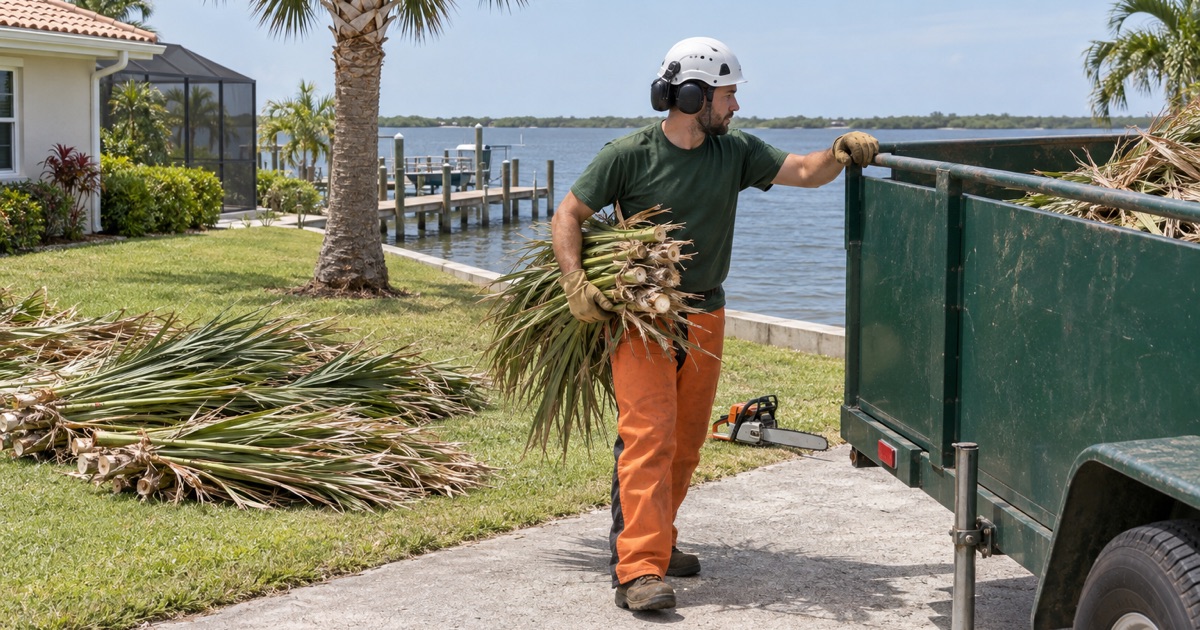
The Pinellas Bayway, State Road 679, is the only road onto this island, and it is a toll causeway. That single fact shapes a removal here: there is no second route for a chip truck that fills early, no back way in for a crane that arrives before the driveway is clear, and no cheap way to fix a staging mistake once the equipment is across. We size the access to the property before the day rather than on it, deciding which machine fits the gate, where a crane sets up, and whether the wood goes out over the water side or the street side.
Gate width decides the machine, not the tree
Much of the interior is dense residential frontage with fenced rear yards and pool decks, and the Isla Del Sol community adds attached homes with shared drives and limited turnaround. A narrow-gate machine reaches a fenced back yard that a full-size loader never will, and a crane pick lifts a limb over a pool cage instead of dragging it through one. That choice comes from measurements taken in advance, and it is on the estimate you sign.
What sits above the drop zone
Duke Energy Florida owns the overhead right of way over trees here, and its published contractor guidance is blunt: never trim or remove trees within 10 feet of overhead power lines, and only qualified line-clearance tree-trimming contractors may work closer than 10 feet. Duke also states that it will de-energize a customer’s own service line at no cost before work is performed around it, which is worth arranging ahead of time on a tight lot. Around a pad mount transformer the published clearance is a minimum of 10 feet in front, with 3 feet on both sides and at the back.
When the owner is not on the island
A large share of the housing here is held for seasonal, recreational or occasional use: 444 of the 626 vacant units in the current five-year estimates. For those owners an inspection has to mean something with nobody standing in the yard, so findings come back in writing with dated photographs of what we found and what we recommend, before anything is scheduled.
Looking for tree-removal closer to Ruskin? See Ruskin Tree-Removal.
One layer of government, and it is the county
There is no Tierra Verde town government to call. This is an unincorporated place, so land use, tree work and code enforcement at every address on the island are answered by Pinellas County: the Board of County Commissioners sets the rules, and the tree desk inside Pinellas County Public Works administers the Habitat Permit a removal may require. A homeowner who goes looking for a Tierra Verde ordinance and turns up something municipal has found the wrong government, and a contractor who assumes a local layer sits on top of the county rules will quote a permit that does not exist.
The code that reaches the lot is the Pinellas County Code of Ordinances, Chapter 58, tree protection, in effect as amended January 23, 2026. Nothing sits above it here and nothing narrows it locally.
Four inches generally, twenty-four on a homesteaded lot
Countywide, a tree with a trunk diameter of 4 inches or greater, and a palm more than 6 feet in height, require a permit for removal, effective removal or transplanting. The rewritten code then sets a far higher bar for ordinary homeowners: on homesteaded, actively occupied single-family residential property, only trees greater than 24 inches in diameter at breast height are considered protected. A 6-inch or 15-inch backyard tree on a homesteaded single-family lot here very often sits below the county’s own threshold before any state preemption is argued at all. Mangroves and buttonwoods run the other way and require a permit regardless of size.
What the code asks for in replacement
Mitigation under the 2026 rewrite is scaled to the condition of what came out. Dead, dying, invasive or nuisance trees carry no mitigation requirement when removed, while healthy, high-quality trees replace at higher rates, with enhanced credit where replant trees are combined with native understory and groundcover. That is a large part of why a written condition report belongs on the record before a saw starts rather than after.
Where the state statute stops
Florida Statutes section 163.045 bars a local government from requiring a permit, application, fee or mitigation to prune, trim or remove a tree where the owner holds documentation from an ISA-certified arborist that the tree poses an unacceptable risk. Subsection (3) also bars a local government from making that owner replant. The section reaches only a single-family detached building on a lot actively used for single-family residential purposes.
On this island that pool is 794 owner-occupied one-unit-detached homes against 2,445 total housing units, roughly a third of the stock. Attached townhomes, condominium units and anything rented or held vacant fall outside the preemption whatever an arborist letter says.
Mangroves route to the county, not around it
The one place the state’s homeowner protection deliberately stops is the shoreline. Subsection (4) of that same statute expressly excludes the mangrove protections of the Mangrove Trimming and Preservation Act from its reach, so a risk letter that would clear an oak clears nothing at the water’s edge. On an island sitting at the mouth of Tampa Bay with Boca Ciega Bay on the other side, mangrove fringe is not an edge case; it is most of the perimeter of the lots we look at.
The permit is not a state permit, though. Under an Order of Delegation and Operating Agreement executed with the Florida Department of Environmental Protection in February 1996, Pinellas County is delegated the authority to issue permits for mangrove trimming, and for mangrove alteration, within the entire territorial limits of the county. Pinellas is one of only eight delegated entities in the state, and it holds that delegation at county level rather than through any smaller unit of government. Applications go to the Pinellas County Department of Environmental Management.
The trimming window that needs no permit
The county’s own homeowner guidance describes a narrow exemption drawn from the Act: mangroves under 24 feet tall, in a fringe less than 50 feet deep, may be trimmed without a permit, and no mangrove may be trimmed to less than six feet in height. Where the mangroves are over 10 feet in height, the work must be done by a professional mangrove trimmer registered with Pinellas County. The delegation agreement also commits the county not to restrict or qualify the availability of that riparian fringe exemption beyond what the Act itself allows, which is why the honest answer at a seawall is usually a defined trim rather than a flat refusal.
Trimming and alteration are different words
Removal, destruction or defoliation is alteration rather than trimming, and it is a separate permit under the same delegated authority. Outside the riparian fringe the county may impose stricter substantive standards than the state, and the agreement preserves its ability to enforce the county land development code alongside the Act. Where a shoreline job sits near Fort De Soto Park or Shell Key Preserve, we plan equipment and debris routes to keep both off the conservation boundary, and we settle the permit question before we quote a cut.
Fill under the grinder, and a gate rate on the wood
What the stump grinder finds
The ground here is dredge and fill, not a natural upland profile. The soil survey maps this island as Matlacha and St. Augustine soils with urban land, and the official series description for the latter records soils formed in fill from dredging operations, somewhat poorly drained, with a water table at depths of 20 to 30 inches for 2 to 6 months in most years. A stump grinder cuts roughly 12 to 25 inches below grade, so the binding constraint on a below-grade cut here is very often that water table rather than rock or a hardpan.
In practice a crew should expect wet, saturated, shell-flecked fill on a routine job, and the depth actually achievable moves with the season and with how recently the table has been high. We put that on the estimate instead of discovering it in the hole, and where a stump needs to go deeper than conditions allow in one visit, we schedule the second pass rather than pretend the first one finished it.
Disposal is its own line because it is its own cost
Wood leaves this island across the same causeway it came in on, and it is weighed at the county disposal complex like anything else. Pinellas County charges one gate rate for municipal solid waste, commercial waste and yard waste alike: $58.86 per ton, rising 8 percent to $63.57 per ton on October 1. A contractor surcharge of $100 per load applies to materials that require additional processing or preparation prior to disposal, and a load originating outside Pinellas County pays an out-of-county surcharge equal to the base rate.
That arithmetic is why hauling is quoted separately here. A large hardwood removal is often more tonnage than climb, and an owner who can see the disposal line gets to decide what happens to the wood: weighed out at the gate, or left cut to length on the property. The county also runs a free mulch program at 15 locations, cleaned through a 45-day natural heating process, which is where clean horticultural material in this county tends to end up.
Storm season, booked before it starts
We book storm-season work ahead of the season rather than scrambling after it, because on a causeway island the week following a system is the week everybody is calling and nothing crosses the bridge quickly. A pre-season inspection is the cheap version of the same job: co-dominant stems with included bark, a palm showing spear leaf collapse, a laurel oak leaning over a pool cage. Getting those onto the record early is the difference between a scheduled removal and an emergency one.
- 20+ Years on This Coast
- Written Estimates
- No Topping, No Hat Racking











