
Bradenton Tree Removal quotes tree removal in Treasure Island the way the city’s own paperwork sorts it: a tree already on the ground and a tree still standing are two different questions at the permit counter, and we settle which one you have before a saw comes off the truck. Getting that backwards is how a simple job turns into a stop-work conversation.
Everything is priced in writing first, and hauling and disposal sit on their own line rather than disappearing into one number. On a barrier island the cost of moving wood off the property is frequently the larger half of the job, and an owner ought to be able to see it before agreeing to it. Palms and hardwoods are crewed as the separate trades they are, because a palm has no branch collar to cut to and nothing about it rewards a hardwood habit.
Two decades of this work on the Gulf coast, most of it where a grinder meets sand and a water table rather than soil over rock, is what pays for that confidence. Cuts follow ANSI A300 practice and directional pruning where a limb has to go, and nothing here gets topped, hat racked or hurricane cut, whoever asks for it. When a tree does not need to come down we say so and put pruning or a cable on the estimate instead; when it does, the reasoning is written down before anything is cut.
Treasure Island, Florida, and a permit question with two answers
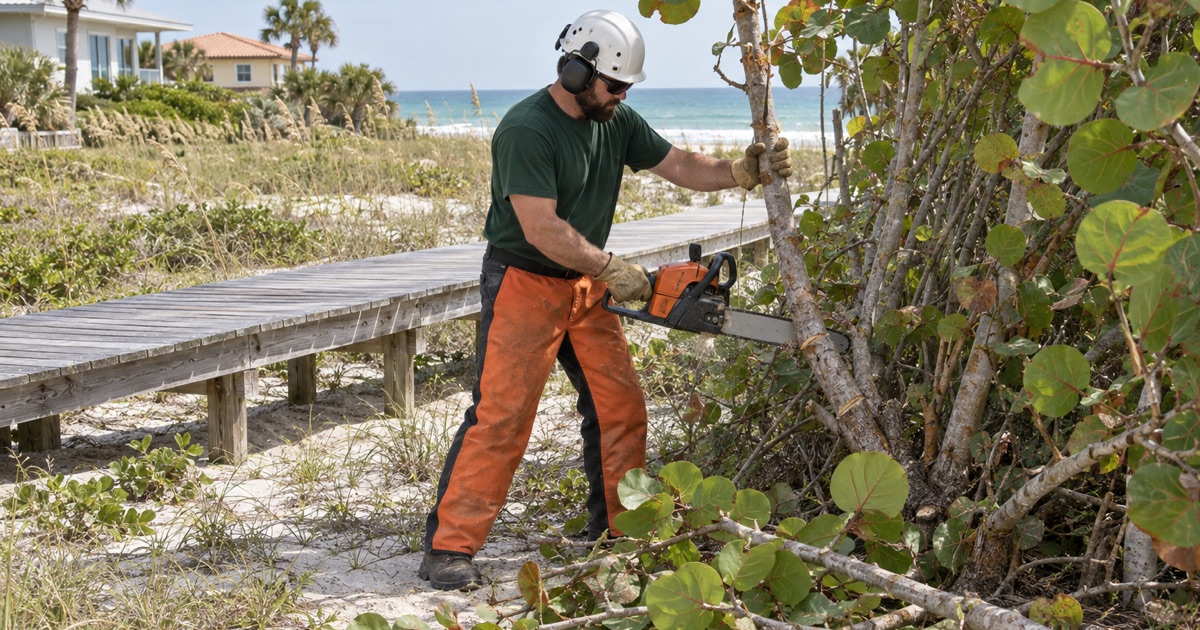
This is Treasure Island, Florida, an incorporated city on a Pinellas County barrier island with its own charter, city commission and building department. Every tree and permit question at a city address is answered inside city hall rather than at the county. The name is shared with an unrelated place on the opposite side of the country, and a plain search for a Treasure Island tree ordinance returns a meaningful share of results belonging to that other one. We check every citation against a Florida government domain before we rely on it, because a rule quoted from the wrong government is worse than no rule at all.
Permits are not required for fallen tree removal
The City of Treasure Island Building Department states it on its permits page in plain words: ‘Permits are NOT required for fallen tree removal.’ That is a local rule and a genuinely useful one, because it is broader than the route the state offers to a similar result. A tree that is already down here needs no permit and no arborist documentation, whether it failed in a storm or gave out on a still afternoon.
The same page separately lists tree removal among the categories of work residents are reminded to confirm before starting, alongside roof repair and electrical repairs. Read together, the two say that a standing tree is treated differently from a fallen one. So we do not quote a standing removal here as though the exemption stretched to cover it.
What that means on a job is a phone call before a price. We confirm with the Building Department what the address actually requires, we pull whatever it turns out to need, and the requirement appears on the estimate as its own item rather than as a surprise the homeowner discovers later. A crew that guesses at this on a small island guesses in front of neighbors who will remember.
What Florida Statutes section 163.045 reaches, and what it misses
The state exemption is a narrower thing than most owners expect, and it is not the same as the city’s. Florida Statutes section 163.045 defines residential property as ‘a single-family, detached building located on a lot that is actively used for single-family residential purposes,’ and only inside that definition can documented arborist risk findings displace a local permit.
On this island that pool is 1,329 owner-occupied one-unit detached homes against 6,192 total housing units, about 21.5 percent of the stock. A condominium unit, an attached home, a rental or a second home held for part of the year sits outside the statute no matter what an arborist writes, and subsection (4) of the same section excludes mangrove protections from its reach entirely.
We build a condition report on the ISA Best Management Practices Tree Risk Assessment framework either way. Diameter at breast height, defect, target and the honest odds of failure belong on the record whether or not a statute is doing any work in the background.
Looking for tree-removal closer to Kenneth City? See Tree-Removal in Kenneth City.
Canal-front lots on a dredged island
More of this city is water than land. Inside the city limits there are roughly one and a half square miles of land against nearly four square miles of water, which is what decades of canal dredging do to a barrier island. Most bay-side lots we look at end at a seawall with a finger canal behind it, and the named canal subdivisions such as Isle of Palms are the clearest version of the pattern: water on one side, a street on the other, and a drop zone that has to be planned rather than improvised.
The ground a stump grinder finds
The state’s own soil layer maps this island as Beaches, a miscellaneous unit in the Entisol order filling 95 percent of the map component, with no named series and no horizon sequence to speak of. With a grinder running that reads as loose, well-drained, shell-flecked sand instead of the spodic horizon a mainland flatwoods soil would put underfoot. Root plates spread wide and shallow in ground like that, so a tree is anchored differently from the way it looks and the rigging plan has to account for it.
Canal-front ground is very likely fill placed during dredging rather than a natural profile, and we work it on that assumption without pretending we surveyed it. It is an inference from how the island was built, not a measurement we took. A stump grinder below-grade cut can reach saturated fill sooner than an inland owner expects, and the backfill settles more afterward; where a stump needs a second pass to finish properly, we schedule the second pass rather than call the first one done.
Access is sized to the lot, not to the tree
A seawall behind, a pool cage beside and a neighbor’s tile roof a short throw off the drop zone are the ordinary constraints here, and between them they choose the machine before the tree does. A narrow-gate machine reaches a fenced rear yard that a full-size loader will never see, and a crane pick lifts a limb over a pool cage rather than dragging it through one.
Those calls come from measurements taken in advance and they are written into the estimate you sign. Where the wood has to travel over water or across a seawall to reach the truck, that is worked out on paper first as well, because a rigging plan invented in the yard on the morning of the job is how a pool enclosure gets paid for twice.
Between John’s Pass and Blind Pass
The island runs pass to pass, with John’s Pass closing the north end and Blind Pass the south, Gulf Boulevard as the commercial spine between them and the Treasure Island Causeway carrying everything to the mainland. Sunset Beach sits at the southern end as the city’s own district. That geography is a scheduling fact rather than scenery: there is no second route for a chip truck that fills early, and equipment that arrives on Gulf Boulevard out of order in season stays out of order for the rest of the day.
Mangroves belong to the county desk
Where a lot meets Boca Ciega Bay or a canal bank, mangrove work is not a city matter at all. Pinellas County holds a delegation from the Florida Department of Environmental Protection to issue permits for mangrove trimming within the entire territorial limits of the county, and this city holds no separate delegation of its own, so the application goes to the Pinellas County Department of Environmental Management. Inside the fringe the work belongs to a professional mangrove trimmer under the Mangrove Trimming and Preservation Act, and we say so plainly rather than take it on as ordinary tree work.
When the owner is not on the island
Most of the vacant housing here is away rather than empty: 1,781 of 2,339 vacant units are held for seasonal, recreational or occasional use, and twenty of the city’s housing units are counted as boats. The person deciding on a removal is often in another state, and sometimes it is a manager holding a key.
So an inspection here produces written findings and dated photographs whether or not anybody is standing in the yard, and the estimate goes out before anything is scheduled. An owner reading it from a thousand miles away should be able to see what the tree is doing, what we propose, and what the wood costs to move, without a phone call to translate any of it.
After a storm, and before the next one
The fallen-tree exemption earns its keep in the week after a system crosses this coast, when a large share of the calls are about a tree that is already lying on a driveway, a seawall or a roof. Nothing stands between an owner and clearing that here, so the constraint becomes crew time and truck access rather than paperwork. It is one of the few places on this coast where the fastest answer is also the legal one.
Power is the other constraint, and it does not clear as quickly. Duke Energy Florida owns the overhead right of way above the trees here, and its own barrier-islands restoration updates have named this city directly as line crews shifted onto the island. Duke will de-energize a customer’s own service line at no cost before work is done around it, which is worth arranging ahead of the crew rather than during it. No one on our crews works inside ten feet of an energized line, because that clearance belongs to a qualified line-clearance contractor and ANSI Z133 governs what happens on the ground.
This island’s own storm exposure is on the record without any need for statistics. Treasure Island Fire Rescue, the city’s municipal department at Station 24 on 108th Avenue, was reported in 2025 to be still searching for a permanent home after damage to its headquarters in the previous year’s storms. That is the operating environment a removal here is scheduled inside, and it is a fair argument for doing the work on a calendar rather than on an emergency.
The failures that arrive late
Storm surge salt inundation does not kill a tree in the week it arrives. Delayed post-storm mortality shows up months later as a canopy that never refoliates properly, a palm with spear leaf collapse, or a laurel oak shedding limbs in still air. We book storm-season work before the season rather than scrambling after it, because those are the trees that fail first, and they are usually the ones already named on a condition report written in the spring.
Where the wood actually goes
Yard waste collection in the city runs through Public Works with Waste Pro as the residential hauler, reachable on (727) 452-5278. Curbside collection is sized for a household’s clippings, not for a mature hardwood, and the volume that comes off one removal is a contractor’s problem by design.
That is why hauling and disposal are quoted as their own line here instead of being folded into a single figure. You can see what moving the wood costs and decide accordingly: hauled off the island, or left cut to length on the property for someone who wants it.
- 20+ Years on This Coast
- Written Estimates
- No Topping, No Hat Racking











