
Bradenton Tree Removal quotes tree removal in Venice against the city’s own code rather than the county’s, and that one distinction decides more jobs here than any other fact about the address. Twenty-plus years working this coast means we have watched the permitting authority at these addresses change hands, and we read the rule that applies today before we price anything.
The work is takedowns, storm-damaged removals, palm work, stump grinding and the hauling behind all of it. Every job leaves as a written estimate with hauling and disposal on their own line, so the cost of moving wood off the property is visible rather than folded into a total. We do not top a tree, hat rack it, or put a hurricane cut on a palm, whoever asks for one.
Palms and hardwoods are different jobs and we crew them that way, because a palm has no branch collar to cut back to and a live oak does. When a tree does not need to come down we say so, and when one does, the reasoning goes into a written condition report before a saw starts.
The city took its tree permitting back in 2020
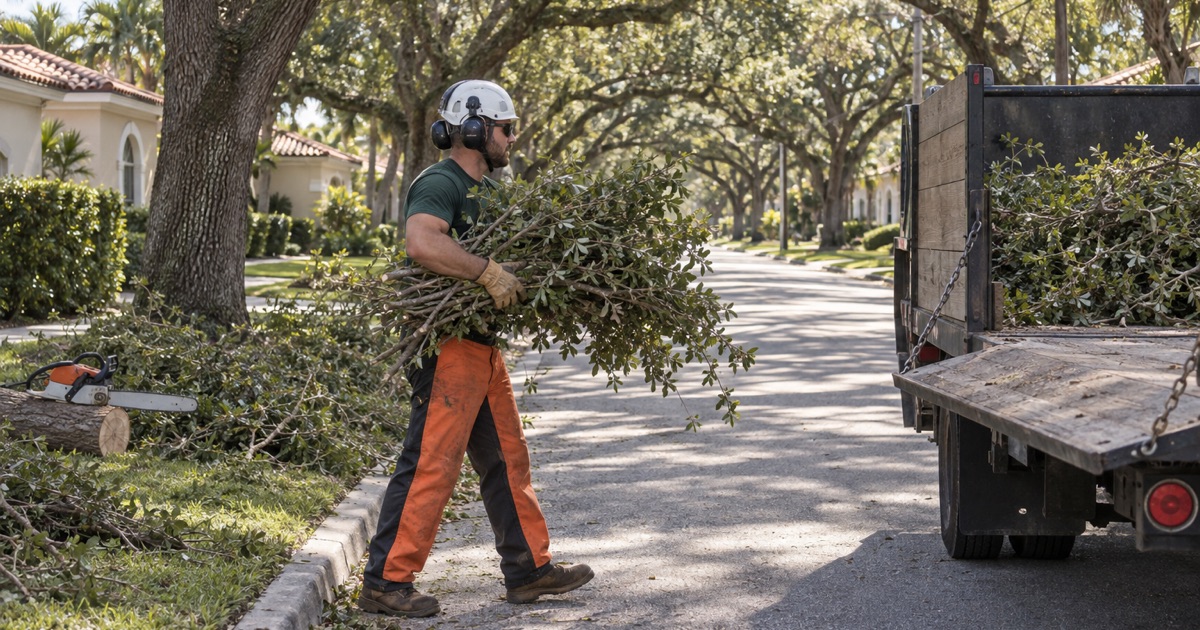
Venice runs its own tree program, and the ordinance that created it says why in its own background section. Ordinance 2019-29 recites that prior to the enactment of these regulations, all tree permitting and enforcement within the city was administered and enforced by Sarasota County through interlocal agreement. City council determined that the regulations for preservation, protection and replacement of trees should be city regulations administered by the city, and the ordinance took effect on January 1, 2020.
That handover is why generic advice about tree rules on this stretch of the coast reads wrong at a Venice address. Sarasota County’s own tree article states that it is effective throughout the unincorporated area of the county, and reaches a municipality only to the extent that the municipality adopts the same provisions and provides by interlocal agreement for enforcement by the county. Venice ended that arrangement when it adopted Chapter 118, so the county article no longer reaches inside the city limits at all.
What Chapter 118 actually protects
The chapter sets a low general threshold before either of its special categories comes into play. A protected tree is any tree over four inches diameter at breast height unless it is an invasive species, and a sabal palmetto with at least a six-foot clear trunk counts as one as well. That is a far smaller tree than most owners assume triggers anything, so we measure at the estimate rather than judging from the driveway.
Who answers the question at a city address
Every tree, vegetation and yard-waste question inside the city is answered at city hall. The City of Venice administers and enforces Chapter 118 with its own staff, and the city’s Public Works Solid Waste and Recycling Division handles curbside solid waste, yard waste and recycling collection within the city limits rather than a franchised private hauler. Private haulers work here only under a city permit and only on specific material streams, so the wood from a removal does not simply go to the curb.
Looking for tree-removal closer to Samoset? See Tree-Removal in Samoset.
Heritage trees and Venetian trees
The two categories the city wrote for itself have no county equivalent, and they are what turn an ordinary removal into a permitted one. Chapter 118 defines a Heritage Tree as any 30 inch DBH single trunk or 45 inch DBH multi trunk native tree the city arborist has determined carries the characteristics the chapter sets out, or any tree designated a Florida State Champion, United States Champion, or World Champion. A Venetian Tree is drawn far more loosely, as a tree of a native or non-native species that has significance, desirability, or utility to the community.
A Venetian designation is not something a tree acquires by growing. The owner nominates it, city council designates it, and the city arborist maintains the registry, which makes the question of whether a particular tree carries the status a records question with a real answer. We check that before quoting, because the designation changes both the permit path and the documentation hung on it.
The pruning threshold, and where it sits
Pruning crosses into permit territory at a stated size on these trees: a tree permit is required for the pruning of a designated Heritage or Venetian tree branch ten inches in diameter or larger, measured 12 inches from the branch union. The permit fee for that pruning is waived, so what doing it properly costs is paperwork and scheduling rather than money. Any pruning not performed in accordance with ANSI A300 is subject to the fines and penalties the chapter sets out for it.
Removal, documentation and inch-for-inch replacement
Taking a designated tree down asks for more than an application. Unless the work is exempt, the chapter requires documentation by a Professional Landscape Architect or Certified Arborist to justify the tree removal, which is the evidence we would want in the file regardless. Replacement then runs at a ratio of one tree inch to one tree inch, with a payment into the city’s tree mitigation fund covering the inches a lot physically cannot accommodate.
Inch-for-inch mitigation on a large specimen is the part of a quote that surprises people, and the estimate is the right place to be surprised. We size the replacement obligation and any payment in lieu of planting before a crew is scheduled.
A half-acre exemption where the county drew five acres
The exemption most owners are hoping for sits at section 118-7(h), and it is narrower than the one it replaced. It exempts residential zoned lots in two situations only: where the pruning, trimming or removal is done pursuant to Florida Statutes section 163.045, and where the lot is single family zoned and one half acre or less. The county’s own residential exemption reaches owner-occupied lots of five acres or smaller, and none of that governs anything inside these city limits any more.
The distance between one half acre and five acres is not a technicality on ordinary lots here. A homeowner who would have needed nothing under the older arrangement can need a city tree permit now for the same tree in the same yard, with no change to the tree at all. It is the most common thing we correct on a first call from this city.
Where the exemption stops even on a small lot
The smaller-lot branch carries exceptions written into the same subsection. Heritage Trees, Venetian Trees, and trees in the Canopy Road Protection Zone are not exempt unless Florida Statutes section 163.045 applies, and trees in conservation areas or easements are not exempt under either branch. A half-acre lot is not a blanket answer, so we read the survey and what is recorded against the parcel rather than the lot size alone.
What the state statute is asking for
Florida Statutes section 163.045 is a documentation route rather than a size rule. It turns on a determination from an arborist certified by the International Society of Arboriculture or from a landscape architect, prepared to a recognized standard such as the ISA Best Management Practices Tree Risk Assessment Second Edition 2017, and the statute has been amended more than once since the ordinance was written. Chapter 118 does not restate those amendments, but it provides that where it refers to another statute it means the most current version, so the statute as amended governs here even though the ordinance predates it.
Florida issues no state tree or arborist contractor license, and Florida Statutes section 163.211 preempts local occupational licensing, so the city could not issue one either. What is verifiable instead is ISA certification, current general liability and workers compensation coverage, and crews working to ANSI Z133 with every cut made to ANSI A300.
The canopy road protection zone
Chapter 118 lets council designate canopy roads by resolution, and a designation carries a Canopy Road Protection Zone reaching up to 15 feet laterally from the right-of-way onto adjacent private property. Inside that zone the threshold drops hard: all trimming of tree branches larger than two inches in diameter, where the trunk stands within the zone, requires a tree permit and certified arborist supervision, with pruning conforming to ANSI A300. We do not treat any particular street as covered or not covered without checking the city’s current resolutions, and no honest quote should.
Mangroves, sea grapes and the ground under the stump
Two plants on this shoreline sit outside the city’s tree chapter by its own instruction. Section 118-16 routes trimming and alteration of mangroves to the Mangrove Trimming and Preservation Act at Florida Statutes sections 403.9321 through 403.9333, and trimming of sea grapes waterward of the coastal construction setback to the Beach and Shore Preservation Act at Florida Statutes section 161.242.
The practical consequence is a jurisdiction question rather than a horticultural one. The state environmental agency has delegated mangrove trimming authority to exactly seven local governments and the City of Venice is not among them, while Sarasota County’s own delegation is limited to the unincorporated county. A mangrove job at a city address runs through the Florida Department of Environmental Protection under the state act, with a professional mangrove trimmer where the work calls for one.
Pople fine sand, and why the grinder story changes here
A stump price quoted by a company that works inland does not transfer cleanly to this ground. The soil mapped at the city’s own reference point is Pople fine sand, whose typical profile runs sand and a cambic layer to roughly 25 inches, carbonate accumulation from 25 to 30 inches, then a clay argillic horizon at 30 to 38 inches, with no spodic hardpan in it anywhere. A stump grinder’s below-grade cut of roughly 12 to 25 inches meets loose sand and carbonate here rather than a cemented pan, and the clay sits below what most machines will reach.
Water is the constraint instead. The series carries a seasonal high water table at 6 to 18 inches for one to three months and at 18 to 40 inches for two to six months in most years, so what a crew meets in the wet season is saturated working ground rather than a buried rock layer. Matting, machine choice and the route across a lawn get settled before the truck is loaded rather than in the driveway.
Storm season, overhead lines and owners who are elsewhere
Hurricane Milton made landfall in Siesta Key in Sarasota County on the evening of October 9, 2024 as a major Category 3 hurricane, and the National Weather Service Tampa Bay Area office logged readings from inside this city: a station named Venice at 68 knots sustained with a gust to 84 knots, and Venice Municipal Airport at a minimum pressure of 972.6 millibars. Those are the numbers behind booking storm-season work before the season rather than joining a queue behind half the coast afterward.
Most overhead distribution here belongs to Florida Power and Light, whose published maintenance plan clears main power lines every three years and neighborhood lines every six years on average, using directional pruning back to the trunk. Their planting guidance asks 50 feet of setback for a large tree at maturity and 30 feet for a medium one, with a large palm’s maximum frond length plus 20 feet. We plan the drop into the rigging rather than assuming a service line will be pulled for us.
The housing stock argues for that timing as well. Of 20,966 housing units in the city, 8,747 predate 1980, and 4,723 of the 5,939 vacant units are held for seasonal, recreational or occasional use, per the American Community Survey 2024 five-year estimates. Live oaks and sabal palmetto planted along those older streets are now at the size where a takedown is a rigging or crane job rather than ladder work, and a fair share of our inspections happen with nobody standing in the yard.
Those inspections go back as written findings with photographs, so a decision does not have to wait on somebody being in town. Access here runs from a fenced back yard that takes a narrow-gate machine to a crane pick over a pool cage, and we size that at the estimate rather than on the morning of the job.
- 20+ Years on This Coast
- Written Estimates
- No Topping, No Hat Racking











