
Bradenton Tree Removal answers one question before quoting tree removal in Wimauma: what kind of parcel is this, and which rulebook follows from that. A removal at a new house on a subdivided lot and a removal on ground that is still being farmed are two different jobs with two different sign-offs, and our estimate says plainly which one we think you have. Twenty-plus years of taking trees down on this coast is largely experience in reading that kind of boundary correctly.
Every owner gets a written estimate before anything is cut, with the removal, the hauling and the disposal each on its own line. Moving the wood is a real cost and it belongs in the open rather than buried inside a single number. Access gets sized to the property as we find it, from a narrow-gate machine through a fenced side yard to a crane pick where the drop zone is a screen enclosure and a new roofline.
We also put the reasoning on the record before a saw starts. Any tree we recommend taking down gets a written condition report first, and where the honest recommendation is a reduction cut, a cable, or leaving the tree alone for another few years, that is what the report says. No topping, no hat racking and no hurricane cuts, on a hardwood or a palm, whoever asks for them.
The land-use map here carries a date
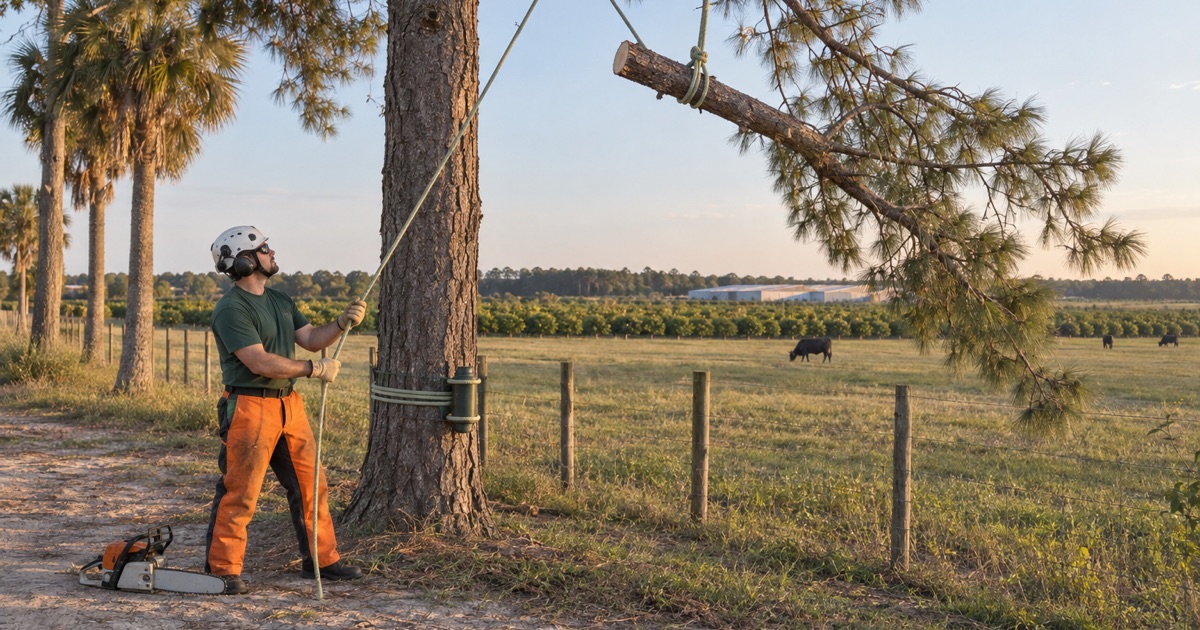
This is not a city, and there is no municipal code sitting above the county. That makes the Hillsborough County Board of County Commissioners the only local government that issues a tree removal permit at an address here, and the county’s Development Services Department, Natural Resources Section the office that actually handles one. The county’s residential guide draws that line in its opening sentence: those guidelines are only for properties in unincorporated Hillsborough County.
Wimauma Village Residential-2, on its way to Residential-4
The Balm and Wimauma Urban Service Area Expansion, Phase 1, is the thing worth knowing about this community if you own ground in it. Through comprehensive plan amendments HC/CPA 24-44 through 24-47, the Board of County Commissioners moved land carrying the Wimauma Village Community Plan’s Wimauma Village Residential-2 designation toward Residential-4. It was adopted on May 8, 2025 and became effective on June 22, 2025. The county’s stated objective is to concentrate 80 percent of the new population growth of the unincorporated county, against a projected increase of over 530,000 people by 2050.
The conversion is already on the ground, not just on the map
American Community Survey five-year estimates count 4,203 housing units here, of which 79.8 percent went up in 2010 or later: 2,220 units through the 2010s and another 1,133 from 2020 on. Only 232 units, roughly 5.5 percent of the stock, predate 1980. A community that grew up around citrus farming, with a first settler recorded in 1875, now treats the pre-1980 house as the local rarity.
Two things follow for anyone hiring a tree crew. The first is that a tree in a yard on the subdivided side of town is often exactly as old as the house, planted with it rather than left standing from whatever was there before. The second is that a real number of parcels have not converted at all, and those answer to a different rulebook entirely, which is the single most common source of bad advice we hear repeated around here.
Looking for tree-removal closer to South Pasadena? See South Pasadena Tree-Removal.
A tree the same age as the house
On a lot built out in the last fifteen years, the tree and the driveway have the same birthday. That changes what we look for. Most of what fails on young suburban stock was set at planting: a stem that forked low and never got a corrective cut, included bark inside that fork, a root plate confined by fill and utility trenching, or a nursery stake and tie nobody ever took off.
Why the answer here is often not removal
Co-dominant stems with included bark on a ten-year-old oak are usually a pruning problem rather than a removal problem. Directional pruning while the stems are still light, or a cable through the union once they are not, buys decades on the same tree for a fraction of what taking it out costs. We would rather write that in the condition report than sell a removal nobody needed. Where the trouble sits at the base instead, a root collar excavation with an air spade tells us whether the flare was simply buried at planting or whether something worse is developing underneath.
What a grinder actually meets under a new lot
The soil survey maps this ground as Myakka fine sand, poorly drained flatwoods on marine terraces, the same series recorded elsewhere in this part of the county. That is a mapped condition and not a measured one, and on a lot graded, filled and trenched within the last decade the native profile may not be intact under the turf at all. So we treat the dig on a new subdivision lot as something to confirm on site rather than assume from a map, and the estimate states how far below grade the stump cut will go, sized to whatever is going back on top.
Palms are not small hardwoods
New landscaping in this community leans heavily on sabal palmetto and other palms, and a palm is a different job from an oak in every respect that matters to a crew. There is no branch collar to cut to, so a frond is severed rather than pruned back to a union, and the nine and three clock rule is what keeps a trim from turning into a hurricane cut. Palms also fail for reasons hardwoods do not, whether that is Ganoderma butt rot, spear leaf collapse, or the potassium deficiency regularly misread as drought stress. We price palm work as palm work, and we do not pencil-point a trunk or strip a frond skirt to make the result look tidier.
Residential lot or working farm: the rules diverge
Parcel classification decides more than the fee here, and this is the point owners most often have backwards. On residential ground the county’s Land Development Code Part 4.01.00, Natural Resources, and its Section 4.01.06 on trees and other vegetation carry the permit-threshold chart, the list of species exempt at any size, and the Grand Oak regulations, and a property here is measured against that chart exactly like any other in the unincorporated county.
The state exemption stops before it reaches a farm
Florida Statutes section 163.045 is the provision people raise first, and on a house lot it is genuinely useful, since an onsite assessment documenting an unacceptable risk can remove the notice, the permit, the fee and the mitigation. But the statute defines residential property narrowly, as a single-family detached building on a lot actively used for single-family residential purposes. Agricultural land is not that, whatever happens to be standing on it, and no arborist letter turns a farm parcel into one. On working ground here the statute is simply not the instrument, and treating it as one is how an owner ends up exposed.
What does govern the ground still being farmed
The county runs its own agricultural exemption to the Natural Resources Permit, and it cuts in the opposite direction from the state provision. It covers activity normal and necessary to conduct bona fide agricultural operations in properly zoned areas, and an operation already existing files no exemption application for tree removal under Land Development Code Section 4.01.03, for ANSI A300 tree trimming, or for limited tree removal and trimming for crop production. The conditions travel with it: qualifying land alteration may not take more than 500 cubic yards of material offsite, may not adversely impact environmentally sensitive areas, and may not divert surface water onto a neighboring property. On the parcels around here that have not converted, that is the regime a tree job answers to.
The transitional ground in between
Cleared and platted lots waiting on a house are where the wildlife rules bite hardest. Gopher tortoise burrows are protected statewide under Florida Administrative Code Chapter 68A-25, which requires a permit before a burrow is disturbed, and burrowing owls fall under Chapter 68A-27, with buffer guidance of 10 feet outside the breeding season and 33 feet during it, February 15 through July 10. Those are the statewide baselines, and we found no Wimauma-specific or county-specific buffer figure beyond them. We walk the drop zone and the machine route on that kind of parcel before the work is scheduled, not on the morning of it.
Inland-zone timing, and where the wood goes
This community sits in National Weather Service public forecast zone FLZ251, Inland Hillsborough, rather than the coastal zone covering the county’s bay-front towns. The two do not always carry the same wind product on the same afternoon. That matters on a marginal day, because climbing and aerial-lift work under ANSI Z133 has gust limits that are not a matter of opinion, and a crane pick over a new roofline has tighter ones again. It is also why we would rather hand an owner a window than a fixed hour when the forecast is still moving.
Book the season before it arrives
Preventive work belongs on the calendar ahead of storm season instead of in the queue behind it. Deadwood over a driveway, a leaning slash pine, a young oak with a union that will not hold: all of it is cheaper and calmer in May than in October. Afterward the wait for any crew runs long and every disposal price moves with the demand. We also see delayed mortality in trees that came through a storm looking untouched, root plates worked loose in saturated sand, which is a good argument for a look in the weeks after rather than a shrug.
Disposal is not a curbside question
Our material does not go to the curb, and the county is explicit that a landscaping or tree service may not put yard waste out on a customer’s residential account. The residential limits settle it in any case, at two cubic yards a week, nothing over fifty pounds in a container, and limbs under four feet long and six inches through, all of which a single removal passes before the chipper is unhooked. Contractor-scale debris goes to a county yard and wood waste gate at commercial rates, most likely the South County Solid Waste Facility on US Highway 41 in Gibsonton for this end of the county. We price that haul from the volume we expect and show it as its own line rather than folding a guess into a lump sum.
Whose answer counts
We work across Manatee, Sarasota, Pinellas and Hillsborough counties, and the answer to a permit question genuinely changes when you cross those lines, so nothing in an estimate written here is carried over from a job in another county. If you are not standing on the property when we look at it, the findings and the photographs come to you in writing regardless, which is what makes an inspection worth anything to an owner who is elsewhere half the year. The Wimauma Community Development Corporation is often the first door a newer resident knocks on and a useful one, though it does not issue tree permits; that question belongs to the county’s Natural Resources Section.
- 20+ Years on This Coast
- Written Estimates
- No Topping, No Hat Racking











